Showing posts with label 1990. Show all posts

Wednesday, April 16, 2025

Spacewrecked - 14 Million Miles from Earth (1990)

The European releases, which use Federation Quest, have a much weaker title screen featuring that red planet below.
Name:Spacewrecked - 14 Million Miles from Earth AKA Federation Quest 1: B.S.S. Jane Seymour
Number:232
Year:1990
Publisher:Gremlin Graphics
Developer:Celestial Software
Genre:FPS
Difficulty:5/5
Time:13 hours
Won:Yes (102W/72L)

I have mixed feelings on Spacewrecked. I first loathed it for unusual mechanics and awkward controls, before considering it for the worst FPS before 1993...which was a fun mental thought considering the usual caliber of worst games I've played...but once I got past the first level the game sort of settled into a scheme so many games from this time fell into; Nice idea, mixed execution.

 The backstory, as given in the manual, tells us that we were sent to explore a distant planet. It turns out to be pointless, the planet had nothing of value. As you lift off, the scattered debris of an exploded moon damages your ship to the point that you can't return to Earth. So you enter cryogenic suspension and wait for your death or rescue. You are awakened some time later to find a fleet of twenty Scientific Survey Craft. Oh, but they're damaged too, they warped into an exploding nova. This caused most systems on-board the ships to become crippled, freed the aliens they captured, and set forth a process which caused mental degradation to the crew. So, you have to find the Energy Flux Decoupler for the power room, the old one is fried, find the inhibit lock and take it to the bridge so you can fly off, then fix the systems of the ship. While dodging everything on the ship that wants you dead. 

"Congratulations, you now only have to do this 19 more times!"
You need to do this twenty times, once for each ship, because of some Interlock Navigation System, which needs every ship to be in operating order or they go nowhere. Basically an excuse for the twenty levels the game consists of. Let me tell you, once you've seen one ship, you've seen more or less them all. They all consist of the same basic layout, the only difference is what rooms are there and what's in those rooms. Even the doors are the same, albeit, some may be locked and some may not. I guess it's imitating the design of a space ship of a certain class, but I can imagine having this as your only game for a month and being somewhat disappointed.
Most of the lower deck, as per the final ship.
You need to do this twenty times, once for each ship, because of some Interlock Navigation System, which needs every ship to be in operating order or they go nowhere. Basically an excuse for the twenty levels the game consists of. Let me tell you, once you've seen one ship, you've seen more or less them all. They all consist of the same basic layout, the only difference is what rooms are there and what's in those rooms. Even the doors are the same, albeit, some may be locked and some may not. I guess it's imitating the design of a space ship of a certain class, but I can imagine having this as your only game for a month and being somewhat disappointed.
A screenshot from the DOS version of the game. It's got some issues.

That said, while this ultimately proved to be more bad than good, I note that the concept isn't that bad. It's quite similar to what would become the roguelite genre, taking the concepts of RPGs and applying them in an action game context. You get twenty randomly laid out ships, more than enough for anyone. This would be fine, if this were the extent of the RPG elements. It isn't, and this is where the game starts to fall apart.

RPG and action are difficult genres to balance together. RPGs rely on character knowledge and skill, action games are the opposite. This is why despite how beloved Morrowind and Deus Ex are, they still have their detractors. When you are playing a game in first-person and the action goes in real-time, when you swing at something, they should be hit if it seems like you hit them. They are loved for the same reason they are hated, they abstract something that is usually just depicted at that level of action. They try to balance the two systems and whether or not this works has been a debate that has simmered over the past two decades. And neither combat system is all that complex either, so this adds to the problem.

Spacewrecked could be said to be in a similar debate. In theory, it applies RPG systems to action gameplay. Similar to, but distinct from, Dungeon Master. We even get a new and exciting version of the combat waltz. Sadly, this is done terribly and drove me up a wall. This is not a RPG in the sense of being derived from actual role-playing games. There are no real RPG components. It's a RPG in the sense of using the level design of Dungeon Master, and the RPG mechanics if you miss or otherwise screw up, because the dungeon master hates your guts. Your attack accuracy is tied into some sort of anxiety your character has. That is, your cursor jumps around so long as you have a weapon equipped and have your cursor over the viewing area.
Make no mistake, the artists on this game loved big heads.
While this goes on, you have to hit whatever it is in front of you. Maybe it's a bear, maybe a T-Rex, maybe a crew member. It jumps around so much it might as well be random. The game then decides if you hit. If you miss, sometimes you get critical failures, like in many tabletop RPGs which for some reason never jumped to computer RPGs. Whoops, hit yourself in the face. Sometimes you break the weapon even when you hit. Then the enemy hits you, and your character's voice lets out a mocking cry of pain. It's not unusual for the deck to be stacked against the player, but this game really feels like you can't fight against your bad luck.
Yeah, that's a sentient rock monster.
Combat waltzing here is replaced with just going back and forward. You can't do anything else against a currently awake enemy except go back and up and down stairs for some reason. Turning doesn't work either, which I think is probably a cheap fix against exploiting it to get around enemies. Enemies occupy the same tile as you when you fight. Back and forward is fine, except that movement is mouse-only, and the buttons have a weird hitbox. Often, I would click on what I thought was one direction, only to turn around or go in another. Even if I didn't move my mouse after a successful action.

I accept that many developers at the time thought that using the mouse only was a good design choice. That some developers decided that making the keyboard, if they considered it at all, just be a lame mouse. I get it, even if it's weird to me, someone who prefers the keyboard to move outside of strategy games. What I do not accept is that I am hitting the wrong buttons. This game was clearly not tested extensively, even by the dev team, which likely explains most issues. There were no testers outside the dev team, because even one would have asked why they thought this was a good idea.
Your character's face gradually turns into a skeleton as you take damage.
That said, while I managed the combat, I did so through save states. You can save and load in the middle of a level, but it takes a while owing to it saving to a floppy. Even with this in place, some enemies were a lot of trouble. There's a crab enemy with a small hitbox which deals a lot of damage. I don't know what the deal is, but it's hard to hit them with a weapon as opposed to a stun weapon. Then there's the partially invisible gnome, he only appears when he attacks. The usual combat strategy goes out the window with him, but at least he stops his attack if you hit him first.
We're just straight up kidnapping humans born on other planets.
Enemies are mostly typical otherwise. Which is odd, because the game has some 20 aliens and a bunch of humans. This is despite the game going out of its way to make enemies seem unique and interesting. The difference is exclusively down to hitbox, their damage and health. I thought one human character tried to run away from me, but perhaps that was just some odd luck, it never happened again. Some enemies have guns, yet they were limited to melee when I wasn't. Even enemies that seem like they should be cowardly just stand their ground and fight me to the death.
Some people on this ship seem to have been missing a few screws before their brains got fried.
It's at odds with what the game is trying to convey. Here are all these complex and thought out characters and it doesn't matter that one is an intelligent, psychic alien, he's going to blindly attack you physically just the same as a bug-eyed metal eating alien. A human wearing a karate gi reacts just the same as a human imitating Shelley Duvall. Why bother with the effort when they all act the same? Why tell me what something's intelligence and hostility is when a fight is always inevitable?
At least with inventory items, it's less built up, and less surprising that it isn't very deep. There are four types of weapons. Melee, a knife and a crowbar. Ranged that have one magazine and they're done, pistols, autopistols and a flamethrower. Rechargeable weapons, blaster, laser sword, and a proton cannon. (I think, I never used it, you'll get why in a moment) Then the rechargeable stun weapon, the electrostunner. Outside of the regular ranged weapons, I thought it was well balanced. A knife for desperate situations, weapons you can recharge and a stun weapon for when you can't be bothered to kill something. There's no point to having traditional gun weapons if there's no way you can reload them, they're just a liability in combat.

All weapons have a reload wait time, even the knife. Less because they have ammo and more so you don't spam it. They each have differing crosshair sizes, and I think this is connected to how easy it is to hit an enemy. I think. If it isn't very clear by now, this game indulges in a lot of obtuse things that would take me more time than I care to spend deciphering. For instance, medical syringes which heal you come in multiple colors. What's the difference, and why was my guy's heart yellow for a while?

For most of the rest of the inventory, this isn't much of a problem. It's a grid-based inventory system, most objects are one tile big, a few are two. If you don't have a robot following along, unless it's a spacesuit or air tank, useful when the oxygen cuts out, the two tile ones need to be in your hand. You get two places to put items effectively, backpack and belt. They each have a different weight limit, 40 and 15. Unless you're grabbing everything you can, this won't be a problem. The problem is that it's slow to open up your inventory screen, pick up something, replace a weapon or even just using an item. Wait for it to open, wait for it to close.

Outside of items relating to functions of the ship, there's not a lot left that's useful. There's armor, but that might not appear on every level. Flashlights function when the lights fail, and in the rooms with damaged lights. Flares and probably candles also fill the same function, but can't be recharged. Repair kits are a vital part of fixing the ship, and for the frequent problems that befall your equipment. A coolant applicator is important for not getting radiation poisoning when you fix the ship. Then there are the function chips for the robots. There's a lot more that's basically just fluff. Ropes and goggles which don't seem to do anything.
A T-Rex, biting my face off, along with an orange door on the left and a yellow or white door on the right. You won't find out until you try to open it.
Keycards are surprisingly important. The game reinvents how doors work. Normally in a game, you would either get a key for a door of a certain color and all doors of that color would be openable now. Or you would be able to unlock just one door and that key would disappear. The important bit is that doors stay open. Here though, they don't. There are a bunch of doors of most colors of the rainbow, with white being the highest security level. Cards go up to white and get drained by the level of the door. Once the card is drain you're allowed to enter the door once. Enemies don't care about locked doors and just go through. Thus, you have to carry around a whole bunch of keycards, periodically going back to recharge them along with your weapons and flashlight.

Time for some nice, refreshing Tang.
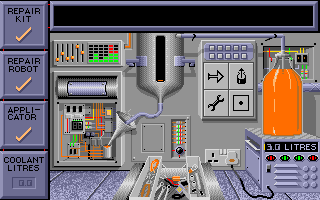
Then there are the bottles, which come in measurements between 1 and 5 liters. This is how you transport coolant to the various rooms in need of repair. This is what you need to do in order to ensure that the ship runs smooth enough so you can actually fight off the horde of aliens and brain fried humans. You find them, or a manufacturing room to create them, then go to a lab to pour coolant into them. This is where the game decides to get cute. Randomly, as in, it is entirely a matter of luck, the game decides that they have a flaw in them, and removes the bottle entirely. You also get to watch each bottle get slowly filled up, in real time. Hope a T-Rex didn't come in.
The ship thirsts for Tang.
So after having managed to get some coolant into bottles, you go to one of the four systems. If you do not have a repair kit, you cannot do anything. You also should have a coolant applicator and a robot with a repair chip in it. The latter is just nice, but the former prevents coolant from spilling...unless you overfill it. You slowly pour it in, then slowly watch as it drains for you repairing it. It's not a guaranteed thing for it to work, even with the robot, but at least it's very likely with the robot.
The bars fluctuate, so you're never entirely sure how good a shape they're in.
From here, you basically continue to fix up every system, making sure the path to everything you need is clear, and just generally doing busywork. At some point, you replace the flux decoupler in the power room and bring the inhibition lock to the bridge, but you'll probably do that before you get every system above 80%, the threshold for victory. My advice is to get 5 liter bottles. The manual says that drains the ship's power more, but unless you're crazy enough to let the game randomly decide to trash your bottles, I doubt that'll factor in much.
Simpler than regular coding, but quite complex for a random game.

And finally, we have the robots. There are six, some mundane, some more useful off the bat, like a computer robot, a medical robot and a repair robot. The game's big selling point seems to be the robot programming aspect. You can basically order a robot to do anything except attack a specific enemy. If it ever attacks anything, I didn't figure out how. For all the effort the developers put into it, it feels quite pointless and possibly even counter-productive.

Taking out the whole attack aspect, you need the number of an item and the number of a room to go there, so you can't have it go anywhere you haven't already gone at some point. So, no using it to help you explore the ship. There is an implication that it can help with bringing coolant to places, but given the trouble I had with doing it on my own, having to manage a robot to do these things seemed like more trouble than just doing it myself. Especially if it had the same failure rate with bottles.

There are four systems you need to repair, not counting the item you bring to the power room. Bio Control handles the stasis of the aliens and the humans. As it fails, it brings creatures out. Despite how important this sounds, I found this a less important target to fix. It's not like the monsters will go back in. The various sources might spawn an infinite amount of enemies, but any attempt to find this out would take so long as to be far longer than you would need to fix it.

Then there's Life Support. This is the most important from many points. It controls the galley, where you can get food, an occasional healing item, lighting, doors, the rad filter and the oxygen in the ship. I'm really not sure what the rad filters do, they failed a few times, but I wasn't suddenly in bad shape. Maybe it causes problems if you also have trouble with overflowing coolant. The doors are the big problem. First, your keycards are drained of one level more than they should, no entering white doors with that issue. Then doors start getting locked randomly. At that point, well, you're pretty much guaranteed to lose.

The Computer, or the bridge, is the most important from the rest of the points. It controls the terminals and recharge stations. From the various terminals on the ship, you can see the ship's status and check the map. It's less effective than a map you would make yourself, but it's the only way you'll find room numbers. The recharge stations are absolutely vital. They recharge the cards, the robot and your weapons. It really doesn't matter if you have life support if you can't reach the bridge.

And then there's communications. It allows you to use the communicators you can find to give orders to robots and find out if you gave the robots a bad code. Oh, and it causes "Communications have failed" to appear when it fails, which often happens at amusing times. Basically, you will only actually care about this if you figured out the robots, and even then, it's going to be the last one.

Visually the game is a mixed bag. A lot of the scenery is good, but then you'll have the odd background object which looks like it was crudely attached to a wall then someone competent tried to do a good job coloring it. The enemies look nice, but they only face you and have limited animation. A few of the enemies feel flat too, like they have no depth to them. Of course, some credit must be given, some failings can be accepted when you're drawing this many enemies and animations. Possibly even for two different platforms. (The DOS version looked far worse than the Amiga version I played for the most part)

The sound design is good, but limited. There's one track that plays at the beginning, then another that plays once you finish a level. I wish there was a bit more. The slow beep of my character's heart monitor in the background isn't annoying, but isn't what I prefer to be hearing all game. And with that, let's get to the rating.

Weapons:

Nice variety, but very quickly falls into a few ones you can easily get. They're also frustrating to use, not a good feeling. 3/10

Enemies:
A lot less interesting than they should be for a game that has more than 20 different kinds of them roaming around. 3/10

Non-Enemies:
I acknowledge that if you're willing to put in the time to learn how the programming aspect of them works, the robots you find are useful. But since in order to actually use them, you need to have the numbers of rooms and items marked down, and their combat mode seems unimplemented, their usefulness is limited to the rest of us. 2/10

Levels:
Twenty ships, with the same layout but different contents. There's not really enough to the game to warrant such length, but if you wanted to play it for that long, you can. 3/10

Player Agency:

Mouse only, and your movement cluster has a poor hitbox. Everything works, but it's generally frustrating to use. 3/10

Interactivity:

Everything is annoyingly automatic, unless it's tied to item use. You go to a galley and eat something automatically or not. There is a lot of stuff here, but it just feels like it's part of the basic game function, not something you play around with. 2/10

Atmosphere:
I'm not sure if this is supposed to be serious or silly, but I enjoy the idea of going through a ship that's been heavily damaged and the crew have gone insane. 3/10

Graphics:
Overall appealing, with limited variation on enemies and robots, with some flat objects and characters. 4/10

Story:
The in-game version of the text crawl seemed not entirely satisfactory, as I didn't figure out why I was being attacked by the human enemies until I read the manual. I still don't know why there was a British bobby. 1/10

Sound/Music:
I think it's decent, but it really could have used some more variety and something beyond a heart rate monitor for background noise. 4/10

That's a score of 28...somehow. I don't quite think that's right, so I'm going to remove a few points for a 26 total.

I think it's far too broken to play unless you really like the genre, but there is some interesting stuff here. Add in some keyboard controls, tweak the aiming a bit, fix the robots and maybe add in some true randomization, and most of the egregious issues are fixed. Obviously there's a lot of tweaking here and there that needs to be done, but the game is uncomfortable enough that things still need to improve before you can start focusing on balancing the enemies.

Reviews of the time solidly stick around the 80% mark. Graphics, sound, controls and the map are soundly praised while the only people to mention the shooting or repairing refer to them as middle-of-the-road. It's somewhat strange. There's also a few people calling this a sequel to Federation of Free Traders, which was published and developed by Gremlin, whereas this game is them publishing something by a different company. From what I understand of the two games, it's unlikely the two share anything beyond a space opera setting.

Next time, I'm not quite sure what I'm going to do. I'm thinking Ixion (Which I have previously misspelled as Ixiom), but there's a bunch of stuff I want to do and work on and maybe the complex Acorn FPS that might just be an open-world adventure game is not what I want to be covering right now.

Monday, September 23, 2024

Pharaoh's Tomb (1990)

The man apparently misspelled his own name, which is something I've never seen before.
Name:Pharaoh's Tomb
Number:221
Year:1990
Publisher:Apogee Software
Developer:Micro F/X
Genre:Side-Scroller
Difficulty:5/5
Time:6 hours
Won:Yes (92W/70L)

There's something deeply unsettling about firing up a game and getting a jump sound effect that sounds like a fart.

Pharaoh's Tomb
is another one of those games from the weird days of Apogee where everything is in CGA even though VGA is becoming a viable platform. It's also one I skipped over at first because I didn't know what exactly this was. Looking at the controls, I wonder if I wouldn't have been better off skipping it. Ctrl and Alt to move left and right? What the hell? It actually does have the arrow keys, but how bizarre.

The story is, you play as Nevada Smith, a research assistant to a professor of archaeology at a major university, who hopes to go on a treasure hunt soon, but the professor never brings you with, having you do research. Deciding against this treatment, you go off to the treasure hunt anyway, preventing your professor from doing so.

The first level is actually quite generous, you can go anywhere from the bottom, but you'll have to wait for the native to get out of the way.
I regret not playing this soon after Monuments of Mars, because I'm genuinely not sure what's new and what isn't. Both are games centered around a single screen a level, which I previously described as puzzlish design. Everything is block-based, including hit detection. Hope you weren't planning on cutting across some spikes, because even if you didn't touch it, because both blocks occupied the same space at the same time, you are dead. Oddly, parts of the game rely on some blocks not taking up a whole block.

What's weirder is that according to sources online is that not only is this not using the same engine as Monuments of Mars, it came out before it. I assume I had good reason to put Monuments in 1990. It's incredibly bizarre, did Replogle get inspired by this game, or did he come to the conclusion that this was somehow the way to design a platformer? Or some sort of strange forced consistency across products. I can believe that this was made before Monuments, since it certainly plays a lot worse.
This one gave me trouble starting out, but it was hard to see why in retrospect, since it isn't actually a cruel version of any of it's tricks.

Basically, Nevada walks, jumps awkwardly, two high and across, and can throw spears because having a gun would be too generous for this game. You can only carry five spears, and presumably five lives. Not that it matters since saving is unrestricted. There are also five masks, which you get a bonus for collecting five of. (I think) Collect 100 of the other thing and you get another life.

In addition to those things, you get keys, two different kinds, red and brown, which I didn't realize were different until I couldn't open one door. A freeze icon, which freezes traps and enemies, which can backfire. There are secrets, either you just naturally open some areas or reveal some platforms by walking somewhere, or you bump your head on a brick and get points. Sometimes the former is more obvious with a scroll which makes changes.

This level's big trick are the two enemies in the middle, otherwise it's completely straight-forward.
There are the requisite traps and enemies. Spikes, moving spikes, and a particularly nasty dart gun which is one black pixel on a normal wall. I have died several times to this. Enemies come in many flavors but they basically just move along certain lines, either on the ground or in the air. Not really enemies, we have moving blocks, which seem to stop if they'll hit you, and the occasional stage with a wind effect.

Getting back to the reason why I thought it would have been better to play this after Monuments of Mars, is that I genuinely don't know if I was in a really good mood for that, if my current personal issues are affecting my enjoyment of this game, or if this is genuinely worse. The collision in this game is so bad that I genuinely thought that you could walk on enemies for a few stages. Yeah, it's that bad.
This was probably my most hated level, since you have to dodge the darts while not really being in control of your movement thanks to the platforms.
The thing is that playing through these four episodes and I have no idea what Broussard was thinking when he placed levels where they are. The difficulty curve of this game feels poorly thought out. The first level is fairly simple, but the second suddenly requires you to start figuring out how enemy collision works. (These are the first two level screenshots) Your spears are limited, so wasting them is extremely unwise. You have to take advantage of the half-tile roof to jump over them, you have to watch out for dart guns and you have to figure out how to walk across sliding tiles.

The dart guns are a more obvious and non-obvious threat. They're obvious because as a threat they are constant, annoying and deadly. They're non-obvious because they are a single tile in otherwise normal-looking brick walls. I feel the need to reiterate this point because they were by far the most constant threat that killed me. Every level with them felt like a gotcha, and by golly this game has gotchas up the ass. They're very easy to miss, and often placed where if you don't notice them ahead of time you can die.

Half-tile roofs quality as the second nastiest hazard. It shouldn't, after all, you just get a half-tile more of ceiling, right? Yes and no, because the game really expects you to take advantage of these roofs to dodge enemies and dart guns. This trick was used so many times it was practically a guarantee that you'd see the two together. It sounds easy, but remember, collision in this game is awful, the controls stick sometimes. So even though you'll do it a hundred times, it's still risky.

Sliding tiles are interesting, from a technical perspective they're like the enemies, they go left and right on certain places, just not killing you. You can even see it in action when they collide with something, they go in the opposite direction. (You can do this with enemies sometimes, it's bizarrely merciful) But going across the tiles is tricky, you seem to have to fight against the movement of the tile if you go in the same direction it goes, and there's a small window of opportunity to get across something. Jumping up can be tricky because of the collision, but it's usually less dangerous than the simple over to another block sideways, more spikes below.

This one is completely straight-forward.
There's an important point to be gotten from these three things, the worst aspects of the game. It's all related to the collision. It's like if The Incredible Machine had its physics designed around screwing the player over as much as possible. Another common but not as nasty trick the game commonly has is a jump over two tiles of spikes, you basically go as far to the edge and jump, hoping to reach the other side. Platformers are allowed to have such strict jumping, but this game does it often and badly. Most bad platformers aren't so bad as to have such a bizarre platforming challenge and do it so often.

This feels like at complete odds with what should logically be the trouble with this game, something like the enemies or the spike elevators, as I took to calling them. They're basically something that only ever killed me because of something else, be it dodging a dart gun, the collision, again, or just plain carelessness on my part. Hey, I can't blame the game for everything! In particular, the spike elevators are weird, because you can touch the pole/rope that moves them, but not the piece itself, and there are very tight corridors.
I note that because I was back and forth on my two computers, I didn't do a good job of keeping my screenshots for this clear, so I used the level select cheat to take them. Hence the weird score.
I think the fundamental problem with this game is that it expects you to do things that the controls aren't really built for. Precision platforming is fine in Tomb Raider or Prince of Persia, it's not fine in a game that seems like it's barely holding together, and it's really not fine here. Because whenever I reached the end of some episode and had to grab a treasure, it didn't feel like the episode was ending as much as suddenly stopping like it was left off in the middle.
It ruins your subtle reference when you make it non-subtle...
Story begins and ends each episode, but even as far as excuse plots go, this feels unnecessary. "You are now in this part of the tomb", blah, blah, blah. Even the big ending cutscene which basically just tells you that your boss is Indiana Jones and that there's going to be another game, where Jones will take some credit on while you do all the work. Which I guess is fitting for an Indy-clone.

Weapons:
An awkward to use spear. 1/10

Enemies:

Obstacles rather than enemies, really. 1/10

Non-Enemies:

None.

Levels:

An inconsistent series of puzzles which requently require precision platforming. Some are okay, but far too often require performing difficult tasks with the game's controls. 3/10

Player Agency:

Every single bad thing I could say about controls I could say here. It sticks and it doesn't register at different times. It's loose and too tight. You have no control over the height of your jump, just the distance. Shooting doesn't work half the time. At least the save and pause functions work perfectly. 1/10

Interactivity:
None

Atmosphere:
It does feel fitting that a long forgotten pyramid feels miserable and desolate. 2/10

Graphics:
Simple, with decent animation. A point removed for the well-disguised dart gun. 2/10

Story:
Overly complicated for something that could be cut down to, find lost treasure. 0/10

Sound/Music:
You fart when you jump, and there are some other PC speaker effects. 1/10

That's 11. Which is the same as The Thor Trilogy. I think that's fitting. Both felt promising at the start, but both screwed themselves over by janky controls and poor level design. Both reminded me of better games. But I think there were times when I truly enjoyed myself playing Thor, whereas this is just sort of meh at it's best.

We'll see Journey to the Center of the Earth...I mean Arctic Adventure after Halloween, I want to alternate between Rejection and whatever it is I decide to play for October.

Monday, September 2, 2024

Xenomorph (1990)

Name:Xenomorph
Number:219
Year:1990
Publisher:Pandora
Developer:Pandora
Genre:FPS
Difficulty:3/5
Time:20 hours 50 minutes
Won:Yes (90W/70L)

I picked out Xenomorph as a sort of filler game, knowing that it was a Dungeon Master-style RPG that the CRPG Addict didn't cover, when the sub-genre is something I think falls into the domain of FPS just enough for it to be a reasonable title to cover under my rules. As I got through more and more of the game, it became clear just how much of an odd duck Xenomorph truly was.

Whenever I hear discussions of game genres on the internet, it's very rigid, a game either is or is not a particular genre, barring the odd 50% or so genre split. You could make many valid observations about this, ranging from the impolite to the polite. I think this isn't quite true, a game can have many elements of a genre without it necessarily being the primary genre, and even what appears to be a game's genre could just not be so.

The only character you ever get, no improvement allowed.

Xenomorph is a good example of this, because everyone says it's a RPG. It isn't. There isn't that much that you could say that exclusively applies to a RPG that also applies to Xenomorph. It appears to be a RPG, though, it plays like Dungeon Master. At first glance. In Xenomorph, you have no stat growth, no role-playing, no, for a lack of a better term, RPG combat. The only thing I can think of that mostly appears in RPGs is armor, this is something that very rarely appears outside of the genre.

As I've said in the past, a Dungeon Master-style grid level is not necessarily a RPG aspect, though most FPS with them are not rigid to the grid. There is no aspect of this level design that is not out of place in Wolfenstein. Nor are food and drink exclusive to RPGs. The way you interact with things might be nearly exclusive to RPGs, but that is not necessarily because that is a RPG trait. It is ultimately as much a RPG as it is a strategy game, minor aspects we probably wouldn't think of.

So, what is it? Story-wise, it's basically Aliens, except instead of being sent to recover a destroyed colony, your ship just arrives after some horrific accident that leaves it badly damaged, and you have to explore the place to repair it. Gameplay-wise, it seems to me to be a FPS, it's in first person, you are a human, and shooting is primarily a player action, not an in-game character action. Obscuring this, is that the game is controlled exclusively by the mouse and has a fairly complicated interface. Only System Shock and Pathways into Darkness spring to mind as something with such a complicated interface, which are FPS/RPG hybrids. This is a RPG feature, but is it necessarily a component of RPGs themselves or just something we assume because FPS generally don't offer enough depth in their equipment like this? Though I say this like I know what the depth of the game's equipment even is.

One of the many dispensers around.
There's another train of thought, that this is a survival horror game. I say this knowing I don't really think it, but I must admit, by the usual logic, it is a horror game and you survive, it works flawlessly. Even better, unarguable logic is that this is a survival game, since you have food and drink meters and have to find food, and it is a horror game. By my logic of survival horror games being Alone in the Dark-clones, this it is not. By my logic of it being an action game with heavy adventure elements, like limited resources, it is not.

Which brings me to my big criticism of the game. Things are presented like you have to conserve resources. In a sense this is true, most resources are limited, money, explosives, and food/water. Except you don't need food, it just allows your stamina to regenerate faster and are presented with enough explosives to render it being limited moot. If you get hit, you regenerate health. Oh, and the ammo for all your weapons can be recharged at one of the many convenient stations around the game. In an action game, if the player has unlimited resources and the enemy doesn't, the only thing that can stop them winning is running out of interest.

One of the many computers, which only displays information found on floppies.

I don't think this is a case of the game being badly designed as much as being unfinished. There's no music, and some systems like food/water and a communicator don't work like the game implies. I get the same impression from this game that I do from games that are 80% finished. They clearly had to ship out an unfinished title, which is unfortunate, because a few more months would have done the game a lot of good.

One of the earlier enemies.

Don't mistake this for perfect, because I don't think combat can possibly be fixed. No matter what you do, shooting is point and click and it's going to be difficult to make a variation beyond fancy explosives or adjusting damage. Enemies you can do a little with, but even with the melee enemies the game understandably focuses on, it seems like there was one train of thought. Not even faster variations, just ones that do slightly more damage and take slightly more to kill.
This is not that much trouble in the finished product because you are expected to move around with the mouse. No hotkeys for moving around, in fact all you can do with the keyboard is do a keypad mouse or switch between your inventory and regular screen. At least in the DOS version, meanwhile, Amiga players can move around, but not turn. It is a problem whenever the game throws enough enemies at you for this to be a problem. At least your weapons are all point and shoot or activation based. Killing them is simple enough until you need to reload.

A fairly typical inventory in the later sections of the game.

Actually interacting with your inventory is weird, because you get a bunch of slots of varying sizes, which all can carry everything from the smallest battery to a rocket launcher. The only slots specific to any items are equipped armor, four slots for ammo and a holster for a sidearm, which works a bit weirdly. Despite the advantages this sounds like it brings, the inventory system is just bad enough that while it works, you can hide items behind other items. It's not obvious where something is dropped and it's not obvious which slot something is in.

This is something that happens when you interact with items at all, the cursor does not have an obvious point when it's your hand, let alone when it's anything you pick up. The big problem is with the cards and floppy disks. The former are how you interact with most vending machines, which are very helpful to essential, such as ammo recharge stations. The latter are your only source of figuring out what happened beyond knowledge gleaned from the title. What, a game called Xenomorph not ripping off Aliens?

There's a distinct feeling that the game wasn't ever really played during it's development, which comes across in most of the problems. It's not this way because the developer really wanted it to be this way, but because that was the way that seemed most obvious and didn't check it afterwards. I get the feeling that the Dungeon Master-style design was not what was originally in mind as much as what they could do. This was built on the ashes of another game, which I suspect is why the game plays this way even though the game takes very little advantage of said style. In another time it would have been a plain FPS or a TPS.

It's not that it's without merit, the game has a more naturalistic design that works well enough in the early half. When it starts to become a series of mazes you can tell that they just sort of gave up on the game. It's just there to pad out the game at that point, not helped by most mazes having the only unkillable enemies in the game.

The way you'd get the most enjoyment out of the game, ironically, would be to go in as blind as possible and just never use the recharge machines. Limiting your ammo gives you reason to use the explosives and to consider what a fight will cost. It makes it so you can't just do what I did and treat the laser pistol as the only weapon in the game and actually puts some tension into the game. Even what I'm telling you is enough to make the game too easy, after all, if you know that the game has enough ammo that you'd have to mess up to lose even without the charging stations, your victory becomes quite assured.

Which I would kind of recommend as while it's not the best game from the era, it is a very interesting piece of experimentation. Despite the frustrations, I found myself wanting to see the end of the game, at least the end of the game's content. The process of fighting your way down to the lowest level to find the necessary pieces of equipment to get off the planet. Not, you know, scrounging through every computer to get enough components to blast off. A fitting end, considering that the story ends without a resolution, with every intriguing question left unanswered.

Weapons:
Normally I appreciate such a large arsenal, but I can't help but look at the number of weapons and the wide variety of explosives and wonder what the difference between some of this stuff is. It doesn't matter if using an explosive is like pulling out a piece of salt water taffy if one flavor kills the enemy just as well as the next. 4/10

Enemies:
As far as I can tell, divided into two variations, just with many different sprites, invulnerable slimes and things you can kill. It's not quite that bad, the end stage shows something else, but for 90% of the game, the difference is going to be visual. Or perhaps weapons advance so well that the improvement is moot. 3/10

Non-Enemies:
None, disappointingly so, as the manual and even the game goes to a length to say that some survivors are around, you just never see them. 0/10

Levels:

Naturalistic and mazey, though the former is only as well done as 1990 allows. Half are basically a series of rooms with the odd sideroom, the other half is more open-ended with the way down/up having multiple paths between. I think enemies were supposed to respawn, because it's really obvious how some levels are empty when there's nothing there. 4/10

Player Agency:
A functional mouse interface with a lot of roughness around the edges. Any cursor outside of the crosshair is going to be a guessing game as to where you actually click. 5/10

Interactivity:
You basically get to press some buttons. Oh, I think there were some locked doors, but it never came up for me. 1/10

Atmosphere:
The game does a good job of appealing to those interested in another game ripping off Aliens, albeit playing up the element of the movie of someone arriving late to the tragedy rather than the focus on combat. It's got enough intrigue and interesting stuff that will last until the final sections. 6/10

Graphics:
Xenomorph's appeal feels tied into a very specific point in time when hi-end EGA graphics were what you strove for, and making the most out of a grid was the best you could do. In these regards, it's great. That said, limited animation is a negative and while the game makes it's ugly-feeling design work, it's still ugly. 6/10

Story:
Despite being just told through floppy disks, I was intrigued by the efforts of the members of this space station trying to fight back the hordes of aliens they found and what they discovered about them. Sadly, because the game is clearly not fully done and there was no sequel, I'll never know the answers to it all. 3/10

Sound/Music:
Outside of a few sound effects, dead and total silence. They're fine for PC Speaker, but there's just so much nothing otherwise it doesn't matter. 1/10

That's a respectable 33.

An extremely easy point of comparison is with the Turbografx game Silent Debuggers, another Dungeon Master-style FPS heavily based of Aliens. They don't really share anything outside of that, but it's weird that there are two of them.

The English reviews all seem more or less glowing. Nothing truly top tier, but all 7 to 9 ratings, outside of one lower rating that I couldn't find the magazine of. There's a lot of people on Lemon Amiga talking about how it was scary back in the day, which I can see.

Another character, oh wait, I need to flip the disk around.

After finishing the DOS port, my curiosity got the better of me and I went to check the C64 port, and I can't help but think that most of the effect went there. Here character selection is implemented, with different stats for each one. You can tell they put a ton of effort into this version, likely some of the stuff that was mentioned in the manual but wasn't included.

I say probably because when I fired it up, it was just so full of disk swapping that playing it would have been an exercise in patience. There's a reason I played the DOS version over the Amiga version despite minor advantages in controls.

Finally, the game was built off the ashes of a Mindware game called Lasers and Labyrinths. Reading about it, I can tell that they worked on this game from what they had from that game, which sounds like it was going to be a lot more of a RPG than what we got. I wonder what it would play like, but knowing it's from the same people who gave us Tracker puts me in the mindset that it wouldn't be as good as this.

Monday, June 17, 2024

Liquid Kids (1990)

Name:Liquid Kids AKA Mizubaku Daibouke
Number:215
Year:1990
Publisher:Taito
Developer:Taito
Genre:Side-scrolling Shooter
Difficulty:4/5
Time:2 hours
Won:No (88W/69L)

One of the oddities of 1992 FPS is an arcade exclusive FPS, which is allegedly quite clever for 1992. Before we reach that however, we'll take a look at one of the designers, Toshiaki Matsumoto, and see some more oddities.

Firstly, Liquid Kids, or as it's known in Japan, Mizubaku Adventure among possibly others, is an arcade side-scrolling platformer/shooter. It's not quite the stereotype of a bad arcade side-scroller, you are not forced between feeding it coins and being bored to tears or trying to replay it from the start and finding it frustrating. I mean, you can still do the former, you respawn roughly where you died, enemies disappear, and even after a continue everything is as you left it. I'll explain why it sucks in a moment.

That's a thing that's been said in English.
The story, told in Engrish, is that you are Hipopo the Hippo, the last of the cute cuddly animals from Woody Lake, and you must go after the Fire Devil who kidnapped the rest. This doesn't really have much purpose to what little story exists, you just get some animals at the end of each stage.

There are three stages a section, most of which depict cute, pleasant areas full of cute creatures who want to kill Hipopo. So Hipopo has the power of throwing water balls. This is not the joke weapon it sounds like. Yeah, it has exactly that arc which means you can't hit smaller creatures at a certain spot, but the game doesn't really have that many...and more importantly, the water balls explode, shooting a flood of water across the ground, downstream. That said, this doesn't kill them as much as moving your rotund creature into the frozen/wet enemies, which shoots them like a billard until it hits a wall, even down levels. Powerups exist which increase the power, but I only found one in the first section.

The problem is, your hippo moves like people imagine a hippo moves, extremely slowly. This effects everything, you can't really dodge, your jump has a very narrow arc, so you can't really dodge or get out of the enemies way. The game doesn't really offer a counterpoint to this starting off, so long as you pay attention to where enemies are spawning and don't rush in, there's no time limit, you'll get by easily.
Enemies aren't very interesting at this stage. You get things with shells which don't seem to do anything special. Seals or something that shoot at you, but ever so rarely. The two trouble enemies are ones with a conch shell on their head, which they then shoot up. That was throwing me at first, because most enemies are non-entities as far as I'm concerned. Then bombs, which have this habit of shooting out flames, I guess them exploding.

They spawn in some places, but in others they slowly trickle in via burning portals. These seem to be limitless, and tied into the slowly darkening sky. They're not the interesting part of the level design, instead, you occasionally get things like water wheels, they're not connected to anything, but if you shoot them, they spin like crazy. Then there are flowers that need to be watered, these give powerups, and fire flowers, which you need to shoot.
At the end of 1-3, I get my first boss fight. It's certainly a boss fight. He jumps around and occasionally opens up to reveal a line of fire which I'm sure would hurt me if it ever hit me. I never died to this, saying it's a joke implies it's funny. It's not fun, because combat isn't fun. It's not interesting, the most unusual thing I had to do was find a choice of words for the not helicopter blade it has. It is, to quote a Rush song, "Why are we here? Because we're here -- Roll the bones." That, or the developers wanted the game to be a minute longer.

After this you get two doors, which determines which of two stages you start at.

Section two is unusual. It's a water section, which by logic of my character being a water creature, should mean I play better, or by logic of crappy video games, it's unplayable. Throw logic out the window, it's the same as other stages, except sometimes your hippo is floating on water and some enemies lie under the water. This actually makes some annoying sections, because said enemies can't be hit with your water attack under the water, but they can above, and it hurts above. Figure it out yourself. Why does it happen? Because it happens. Roll the bones.
This is actually enough to shift the game from basically a joke to challenging, but not very interesting. It's very easy for the enemy to pin you down here, moving over water while there's a horde of fish is not going to end well for you. This really eats up the lives, but it's still more of a failure to deal with them then them being cheap. They're very slow in reaching you, which puts you in an annoying place.

The boss of this section is unusual. He's somewhere between the first boss, here because he's here, and a serious boss. He shoots out sponges, which are water absorbing landmines, but he himself is very vulnerable to your damage and if you hit him from above, he's just wrecked. His movement is very predictable, except for one moment, otherwise you basically take him out easily.
This brings us to the fire section. The first fire section if the map screen is any indication. You want to know a coin munching section? Here's a coin-munching section. For starters, you have to make a blind drop onto a singular platform, everything else is spikes, or get lucky with a moving platform. Then there are falling blocks, at the end of which is a strange, and big new enemy. He's tough, but still stupid, he has body parts you have to dismember. That's a strange consideration in this game.

Saying this section delights in torturing the player is an understatement, because I feel like everything the game could do to screw over the player is put here. Platforms that move up and down? Well, you won't get crushed, but they're going to put spikes halfway up, at the top, and possibly somewhere else to, because you paid money to play this, you will suffer. That said, this wasn't too bad when I went through my second time.
Then we have the metal knights. My first thought were that they were like the knights from the Zelda series, but they're just as dumb. No, what makes them nasty is that they're fast and it doesn't seem like you're damaging them. This is extremely tight quarters, they will kill you unless you know what you're doing. Before the fire stage I could at least pretend to be trying to 1CC this, but no, there's no chance of that now.
There's a train at the top, and some more types of enemies. I don't know how you fight the train, or if you can. Fighting a train is kind of like fighting against technological progress itself, impossible. Or I'm just missing something. Maybe this level wasn't simply a series of memorization challenges and there's something to it.
The second stage is really just more of the same, but the boss is interesting. He killed me quite a lot, but I can't say I mind too much. He's like the earlier big enemies, tough and with multiple parts. The saw blades don't seem to hurt you, but he pumps out enemies, and shoots flames once both parts have been removed, which is the bigger issue. It's actually a lot easier than I thought, and requires using all three levels of the area.
Egyptian section, basically tricks and traps. The new enemies are kind of clever, there's a conch shell that, if you move into it, will turn into a deadlier version of itself. Then there's the annoying enemy, a reaper-looking dude with a grabber. He grabs you, and you're not dead, but you'll wish you were. He moves you into a different level. Sometimes it's just back a few places, other times it's a nasty repeating loop.

I actually really liked this section, except, it's also where the game ended for me. See, there are a lot of clever tricks here, which isn't surprising considering how much it screwed you over. No, the problem is that at one point, the game had a spring, which functions much like you'd expect one to function, except it just isn't enough to reach the next platform. What is? Dunno, but no matter what I do I can't seem to get up it.

Despite my issues, I did enjoy it. It's well-polished, but perhaps too much so at times. It seems oddly Amiga-ish at times, pretty sure they used a real human whistling in one of the music tracks, which in the west would be a tell-tale sign of .mod music around this time.
I don't have any reason to show this, I just like how goofy it is.
Weapons:
I can't help but like, despite the game basically forcing you to use a grenade weapon exclusively, as a crutch. It shouldn't work, but it does. 2/10

Enemies:
There's a wide variety, ranging from an interesting challenge, to just hammer them with your water balls. 4/10

Non-Enemies:
None.

Levels:
For as far as I could reach, there's some clever tricks going on. Each stage has it's own gimmicks and tricks, keeping each one unique in both design and looks. Also, there are little side stages you can find my watering the right spot, I only found two and entered one, not sure if there's much point to it. 4/10

Player Agency:
Outside of rare power-ups, you move incredibly slowly with such a bizarre jump arc. When serious enemies come around, any positives the rest of the game had more are more than ruined when you have seemingly no chance of escape, that is, outside of quarters. 1/10

Interactivity:
Feels like just guessing where to hit with the massive amount of water you get rather than any conscious thought. 1/10

Atmosphere:
Feels like the world you get in an intro cutscene before the villain turns all the cute animals into demons, yet it's also the after effect of that. 4/10

Graphics:
Cutesy, well-animated and generally nice to see. Sometimes feels a bit too bright and cheerful that it hurts my eyes though. 7/10

Story:
Vague Engrish, not very exciting plot. 1/10

Sound/Music:
A bit too soft-spoken, to fit the vibe of the game. Some are nice, but it felt like no matter how high I brought up the volume I was hearing it through a pair of tin cans. 3/10

That's 27, not bad for an arcade platformer.

Almost universally this game seems to have met with praise, which I sort of understand. There's a port of this to the PC Engine, which is probably inferior in many ways, and ports to the Switch and PS4, which are from those kinds of allegedly arcade perfect ports that every company these days brags about.

Next week, we'll probably see Space Gun, maybe Rejection. This week has had some very time-consuming problems, and next week there'll be more. I try to keep things to every Sunday, but I hope my readers will forgive me if the next post is on a Monday.