Name:Tomb Raider
Number:200
Year:1996
Publisher:Eidos
Developer:Core Design
Genre:Third-Person Shooter/Platformer
Difficulty:4/5
Time:14 hours
Won:Yes (81W/64L)
The game that put third-person shooters on the map, despite not being very good at being as third-person shooter. The game that also put sex appeal in games on the maps despite games doing that long before this. The first 3D cinematic platformer. In retrospect, it's not really hard to see why history has felt the need to condemn the game since cinematic platformers were only ever really popular thanks to the spectacle of them. All of the concepts used in Tomb Raider have since fallen out of favor, it doesn't matter how good the game is in the end, that lack of fashionability is always going to triumph over fun factor.

So, let's get the most controversial aspects out of the way first. Lara Croft herself. The aristocrat turned self-made woman. There's a lot of talk about her character ranging from a feminist fantasy to the opposite. Usually both statements are from people who would not make the argument for anything else. People who are anti-feminist arguing up Lara's feminist aspects, people who are feminists basically calling her a whore. There's a vitriol around this character that I only ever see otherwise said about female politicians. I don't feel like repeating them. The former is arguably just the usual political grifting, the latter feel like they're genuinely slighted by the existence of a fictional character. A character who isn't that important in the grand scheme of things beyond being a danger junkie going into this not because she's a hero, but because she gets a kick out of it.
I'm alluding to it, but Lara's not a complex character, yet somehow this amount of character has eluded most people. The manual talks about how Lara used to be a member of the nobility til she decided to leave it, becoming a world traveller, that's her actual job, not raiding tombs. Even the in-game story sets her up differently than you would expect, she's not in this for money, she says as much, she's an adrenaline junkie. Sort of the purest representation of a player's desires, to fight bizarre creatures and explore strange locations. Well, the average player's desires, anyway.
Thinking about it, it's not so much an unimportance placed on her character that makes her the target as much as being a right-wing ideal. A woman who pulled herself up by her bootstraps, while also being an old money aristocrat beforehand, really likes guns, has no qualms about killing animals or locals. If we throw in points from later games, a Christian who, despite the great power of artifacts from other religions, ultimately prove powerless against the might of a single believer, as well as taking down ancient conspiracies who secretly control the world. Absurd, of course, but I don't think it's the most absurd statement ever made about Lara's character.
For a character who has produced so much analysis and critique, so much of it is shallow. Men referring to her as a sex doll, which I feel like reveals a whole lot about the mental state of the speaker rather than the character. The kind of men who make assumptions about women who have certain kinds of bodies. Women referring to her as competition, which sounds like a self-fulfilling prophecy. Are you really that unpleasant a person to think of a fictional character as possibly being better than you, even counting that the character is fiction?
I just don't see the hype beyond, oooh, hot chick. This isn't a movie, you don't really stop to oogle the protagonist unless you don't actually want to play the game. As a general rule you're not looking at the protagonist as much as around the protagonist. You have to concentrate on actually playing the game as opposed to staring at polygon butt and legs. This feels like something that only happens if you never play the game and instead watch other people play the game.
 |
Wall textures are very pixelated, sometimes this works, sometimes it doesn't.
|
Then there's the other controversy, about this game's controls, I guess I should address that. A lot of people say tank controls, clunky or just outdated in a way that feels superficial. In a sense it is the latter, but unlike say, Bubsy 3D this is less like a technical limitation and more a conscious choice. Tomb Raider was never really in-date, it was trying to take the controls of a game like Prince of Persia and put it in a 3D environment, and at this it succeeds beautifully in a way that people criticizing it don't really get.
 |
It's hard getting good jumping pictures because the keys for these actions happen to correspond to unpleasant ones for taking screenshots.
|
What I mean is, the game's very precise, Lara does precisely what you tell her to, no more, no less, as a real person would, if she were an olympic level athlete. The expected actions, run, jump and shoot. Weird actions, like pressing back causing a short back jump are in service to this. Lara can grab onto the edge of any tile that's level enough. While this game doesn't represent insanity in the service of realism like, say, Splat'ers, it is trying to make something more realistic than a Mario game where you're given an extreme amount of leeway in platforming. A balance of fun and realism.
Let's take, for instance, walking. Pressing walk causes Lara to walk, you do this so Lara doesn't fall off a ledge. She goes like any other platformer if she just runs. In practical terms, this represents her paying attention about where she's going in the former and not paying any attention to where she's going when running. You don't run off a ledge. In gameplay terms, the former is necessary because Lara should be facing flat towards her target, an angle and she might miss. Or you might need to look around from that ledge. If you wanted to go off a ledge, you could run off, probably die from fall damage, or turn around, back jump off the ledge and grab it. Or press the roll button and fall off weird.
But if Lara needs to jump over something, she can then do so, grabbing it if necessary. Keeping in mind that there is a difference in her jumping capabilities grabbing a ledge or not grabbing a ledge. If need be, she can do that short back jump again, which is precisely one tile in length, the length needed to do a running jump. Lara always takes at least two steps before doing one, if she's in the middle of a run and you press it, she'll do it at her next step. This is often criticized, but like everything else, Lara always does it in a certain way, one you can do on the dot every time.
 |
Only rarely are areas so big you cannot see one end from another.
|
While the tiles are not the most aesthetically pleasing graphics around, they look like that for a reason. Soon enough in any given area you should be able to see where Lara can go. Lara can jump across two tiles level, meaning she can jump over any one tile gap and grab the next ledge if she is so ordered. With a running grab jump, she can reach across three tiles. She can even jump up one tile if you do it right.
I feel like this is one of the few platformers which actually gives the player a character that actually feels like they're jumping. A lot of platformers give players so much leeway it doesn't really feel like they're jumping, you're basically a bouncy ball. There's a sense of weight and movement that arguably hasn't ever been achieved in a 3D game since. You're either jumping when one pixel of your foot is still on the platform or the game practically plays itself. Tomb Raider actually tries to make the platforming feel like platforming and get unfairly crapped on for it.
 |
The pillar to the left is one such object, and isn't a problem because you are exceedingly unlikely to run into it.
|
The only time the game actually fought me as opposed to it being my fault was with 3D objects, that is, objects that are not the walls that exist in 3D space as opposed to being items or enemies. These things always screw around with collision for some reason. If you're lucky, Lara just won't go there, if you aren't, Lara will jump around to a place you don't want her to. This happened to me twice that I can remember. The first level with ropes on the bridge, which is partially my fault because nobody playing the game is just going to try to climb up the bridge. In Egypt with one of the Sphinxes, with its nose thing being one such object.
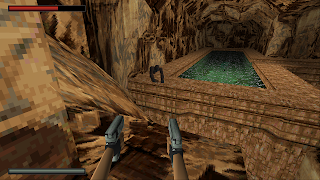 |
Look ma, it's a first person shooter. (vomits after doing a jump)
|
The camera isn't great, of course, but it generally works unless Lara's back is against a wall. Which does happen a lot, but not cripplingly so. It's usually behind Lara's head, meaning usually directly behind her or focusing on whichever enemy you're shooting. If you need to look around, you can always press the look button, very useful for seeing what's below. For a game designed at this point in time, the camera works remarkably well.
 |
Rarely are there traps underwater.
|
Swimming is simple. You can't fight down here, so you're a sitting duck in or getting out of water. Some levels take advantage of this. Otherwise Lara takes to water beautifully, she feels faster down there than in land. She has an air supply, which, while not absurdly generous, does allow you significant leeway. Lara slowly runs out of health whenever her air is gone, which you can stop with medikits if you really need to.
Combat is interesting with this system, because the controls are made for platforming, not shooting. Lara pulls out her guns whenever you press the activate weapon button or switch weapons. Lara automatically shoots whenever you hold down the ctrl or action key. She shoots in front of her, or at an enemy if one crosses her sight, even if that enemy is dead. Which sounds like a problem but the game is so generous with ammo that it really isn't. Even discounting how Lara has infinite ammo for her regular pistol.
Most enemies are faster than Lara, so you have to use positioning to avoid getting hurt. Kind of like a more modern game. You can jump around, but I didn't because of system problems, so instead I had to figure out how else to defeat the enemies. Rather than just standing on some pillar or just tanking hits. Enemies have tank controls too, and they can't turn very well. Most enemies can't, anyway, so simply running around them in a circle prevents them from ever hitting you. Unless they can shoot back. By the time you fight enemies this doesn't work on though, you usually have the method to survive anyway.
 |
All three of Lara's better weapons are here, but some are harder to see than others.
|
There are four weapons, three of which you have to find multiple times throughout the game. The first three are basically the same, Lara shoots both in tandem, and if an enemy goes too far to her left or right she just shoots one, not shooting at all in an area around her back. She'll return when you turn back. Keeping the action pressed ensures Lara can go back to shooting it when she sees it again, rather than just shooting at the air. The pistols just shoot, the magnums do more damage while the Uzis have a higher firing rate.
The shotgun is the exception to this rule. Lara fires, pumps the shotgun and takes aim again. It has the highest damage per second of any weapon, but it takes a moment between shots. Lara also has a different firing arc with it and can't shoot it while jumping. There are also much less ammo for it compared to the other two, which at some point you could practically just use it without ever running out.
Combat isn't really great, but it's helped by how satisfying it feels. The sounds, and the animations just feel so impactful. The pound of a shotgun and the death growl of some strange animal. The snapping that ensues when something very bad happens to Lara. Considering the whole mainstream appeal of the series was Lara, it isn't surprising they made the combat animations just as interesting. This is ultimately an illusion though, as the combat itself is mostly just breaking up the sections between exploring.
Now that we have the requisite complaints out of the way, let's talk about the very good parts of the game. Level design. It's great. Given what I said about the game's controls, you would think the game couldn't do much that was exciting. You would be wrong. For a game that seemingly has such a limited skillset, there's a lot that it does and yet still leaves possible. I estimate that what I saw here is about a third of what can be done, half if you count Unfinished Business.
There are five distinct levelsets to the game, Croft Manor, Peru, Greece, Egypt and Atlantis. Croft Manor is a separate option from the others, it's a tutorial. It explains the movement a bit more simply than I did, but it is interactive. It introduces most non-combat moves, except the roll, in a rather open environment and swimming, which you'll otherwise only find out about when it first pops up...
Peru is the first real levelset, and goes over quite a wide area. From caves to an ancient city to a green valley to finally a bizarre ancient tomb, this has the most variety to it. While later levels certainly do have variety, this one is such that each level has a distinct visual flair to it not seen in the other levels. We begin in The Caves, a fairly typical intro level, doing a good job of introducing you to it, everything is gradually introduced. It's everything an intro level should be.
It does introduce a few key elements in the design itself rather than things like collapsible floors. Exploration is rewarded. While you will never get put in an unwinnable situation, you can make things harder for yourself by doing things the wrong way. Here it's relatively painless. Relatively.
 |
You know, I never saw those skulls again either.
|
This is followed by City of Vilcabamba. It's here that you first start collecting ammo, you're going to be doing that for a while, even if it's usually just in secrets. This level also introduces moveable blocks, something you could very easily get confused by if you're one of those people who didn't have the manual. This one introduces actually deadly elements in it's traps and enemies, though before you could maybe see some if you failed a jump or two. It's starting here that you're liable to actually die as opposed to just needing a medikit.
Two more key elements of the design are introduced here, but in subtle ways. A lot of levels have these big central hubs you gradually go around until you find the way out. This has what I assume are individual buildings that you solve then find a jump in-between. The second are big secrets, not quite as big as say, Blake Stone, but big enough you could assume it was part of the actual level. This is another game where if you play things casually and don't look for stuff you're going to have a hard time later, and unlike games where that makes ammo conservation an issue, this just makes it less fun.
 |
Where this takes place is quite confusing, it's supposed to be a hidden valley, yet because of then engine limitations, you get black ceiling. Remakes make it blue, but since this is supposed to be in an area next to a snowstorm, this doesn't quite make sense.
|
So you enter some strange valley. Corpses abound, and while you have seen a few before, perhaps even got a shotgun off one, not in this volume. Then out comes a raptor. This, it has to be said, is a very effective moment. Until now, for all the player knows, this is just Indiana Jones with hot female protagonist, very mundane and normal. These guys pop out, and the tone changes significantly, for the better. Now, anything can happen. This tone shift also marks the point where the player can no longer sleepwalk through the game, these guys can take a bite out of Lara. Though it can be easily avoided once one figures out that most enemies can't really deal with Lara running around them in a circle.
 |
Even with extended viewing distance, this works really well.
|
Then a T-Rex pops out. The game's first boss. This is about the only boss the game does well, you aren't necessarily expecting him, and you can mostly deal with him mundanely. Mostly, he has a one-hit kill attack which is incredibly cheap. Then some more raptors and you have the valley to yourself. This is one of those sections where Tomb Raider shines, big open places with a half dozen secrets that make the player feel like he could go anywhere he wanted in the game.

Tomb of Qualopec is where the game begins showing it's true nature in being a difficult platformer rather than a nice, fun romp. Up until this point, the most difficult jump you were required to do was in The Lost Valley, which required you to understand that there was a difference in jump length between Lara just jumping and Lara jump grabbing and getting the most length possible out of it. It's not that big a deal if you were doing all the secrets until now though, since by now you've probably seen one of the worst ones. Because now you have to do diagonal jumping.
I use this term for jumping diagonally across a tile, as opposed to the usual jumping straight along a line as you should be doing. See, this is where that tile based design came in. Lara walks to the edge of a tile, does a small back jump, then runs off. This is what the game trained you to do. Then this level pulls the rug out from under you and gives you places to jump to that are not directly across from where you are. It's a bit tricky to get used to, which is why the game puts spikes under your first encounter with them.
 |
"Oh, no, I am going to get rolled over."
|
There are three important introductions in this level. The first, most obvious and least important is the rolling boulder. Why wouldn't you have one of these in a game about exploring tombs? Boulders fall down whenever the designer decided they should fall down, usually by Lara stepping 2 tiles away, and go in a single, usually obvious, direction. There are basically three methods to dodging these, getting out of the way, not knowing you activated one to begin with, and hanging from a ledge. The second one is where being savvy about these things results in the player getting killed, if you jump thinking it'll hit you, you'll jump into it. Boulders aren't instant deaths, but they do hurt if you jump past one. The third the game introduces later on, where you hang from the ledge where the boulder is about to roll over, not on the ledge where the boulder is rolling to, that will kill you.
 |
Surprisingly, you aren't about to get hit in the back...
|
The second important thing is that there are nasty creatures here. These are Atlantians, who you only find out about gradually as the game wears on. Here, you can shoot one, but it doesn't shoot back. Don't worry, by the end of the game you'll be sick of them. Each area corresponds to a tomb of one of the three Atlantian kings, Qualopec is here. They're connected to the item that Lara was hired to find, the Scion, which was divided among the three kings.
 |
...at least not that guy.
|
The third is that the person who hired Lara, Natla, doesn't really trust Lara, and sent another guy called Larson after her, introducing ranged enemies to the mix. Later ranged enemies have some minor strategy to them, Larson does not. Larson just acts like Lara but with a Texan accent, his shooting deals damage effective over time whenever you're within his range. Unlike Lara he doesn't dodge. If you kept shells for that nice shotgun you found off that corpse, you can take Larson out with it.
Story-wise this is the kick the story needed. Until now, this has been the story of a self-made woman going on what amounts to another adventure. A game like this doesn't really need a story, but it helps. Now that we're wondering why Natla tried to kill Lara for what is seemingly no reason. Lara breaks into Natla's HQ to find information on the next piece.
St. Francis' Folly [sic] set in Greece. This is where the design of Tomb Raider becomes complete. Before now, you were generally on solid ground, and while this always has solid ground, now there's a hell of a lot more platforming. You're platforming a lot between very high up pillars, ledges and whatever. Fall damage isn't some unhappy accident, it's a guarantee if you mess something up. Slopes, that is, tiles with so sharp an angle that Lara slides down it, become less part of the scenery and part of navigation.
Now, Greece in general has it's own design language. Each level has a way out you need to find a bunch of items to reach, and you need to get those items from little mini-areas. These are always so fun because they make something oh, so, clever in each. Of these, St. Francis' Folly is my favorite, with it's great downward shaft, containing four mythological challenges.
New enemies here are lions and gorillas. They're basically the same as the wolves, both are stronger, but lions are faster. I shot so many gorillas that I made a joke that Lara hated Jane Goodall. You also get litterbug and fellow adventurer Pierre DuPont taking potshots at you a half dozen times each level. In the original game he would flee when his health went down to half and disappear in the fog. Here he just sort of disappears into thin air. There's not really much to fighting him.
The real new challenge here are the crocodiles. On land, they're really fast, but they can swim. They don't move between land and water, rather they stay in one unless you adjust the water level elsewhere. Larson took potshots at you while you were in the water, but the crocs represent the first time the game has put you into a situation where the water isn't safe. (there are also rats, but they're not really worth talking about)
The Colosseum is a big colosseum. You pretty much get what you were expecting. Big area, more platforming like you'd expect, some nice lever puzzles in an area under the arena. Not really an area with much to talk about, but it was fun at the time. Kind of violates the general design that this area is going for, since you're not trying to collect a bunch of items to reach the way out.
Palace Midas is another level with one of those iconic moments, in this case, a hand of a statue of King Midas, which turns Lara into a gold statue if you land on it. It's a relatively pointless death in a game that delights in trying to kill you. What I feel is more shocking is a section where you enter a room with a large pillar, do the usual journey down to find a lever, and then hear a loud noise. When you return, the pillar has been destroyed and sand has filled part of the room. Level changes on such a vast scale are something that didn't really happen before...or since.
Up until this point I've had almost zero complaints about the level design, outside of some things being a bit too hidden. This level makes that a problem, it's almost too good. What I mean is that I don't know what's the way forward, what's a secret and what's just an optional extra. Things I wouldn't think are secrets are secrets, and things I would think are secrets are the way forward. I daresay the game would get a perfect score from me except for...

Cistern. That's not to say I dislike this level in it's totality, I like the big hub you spend most of the level moving around, it's another awesome level. You have to fill it up and drain it multiple times in order to reach each door, since you need to find a bunch of keys. I like the end, where you fight on a chess board, with some of the tiles being collapsible ones. What I dislike is that this level seems to expect you to do some considerable backtracking, while that isn't entirely unusual, you're basically taking a short trip over an area you've already been in, this is quite noticeable. While most of the level is fine, the last chunk involving the main room overstays it's welcome. Doesn't help this level has a rat squeaking in the backing track throughout the entire level.

Tomb of Tihocan is the one level I think could use some significant cutting. While all levels have been connected to the next, this one really just feels like the last level going on for longer than it should. That said, it still has what I think is the best fight in the entire game. Except now considerably more linear. There's a statue that you haven't the slightest indication of anything being wrong, and when you open the door next to it, out pops a centaur that shoots exploding plasma orbs. This is a classic example of old games working wonderfully, one moment you aren't suspecting anything could be wrong, the next you're fighting some cursed creature. Oh, and you finally kill Pierre afterwards, and if you haven't already, you get the magnums.
 |
I can't forget that there are like four sphinxes in this level because why wouldn't there be?
|
This leads to Egypt and the City of Khamoon. While all levels have generally flowed into one another, this levelset is the one that feels the most like one big level. There's an area here that you see at the beginning of City of Khamoon, and then in the next one you return to it to reach the final level. Egypt is where some people cite fatigue with the game, I even had it here whenever I played the game before, but this time I didn't really feel that way. Perhaps it was because I'm used to playing awful games that I savored this, perhaps it's because I was trying to minimize my number of saves. Egypt feels like a natural thing to place as the second-to-last levelset since Egypt is the stereotypical place for a game like this.
 |
To get all the secrets on this level, you jump from that left pillar, to the central pillar, then one obscured on the other side.
|
Egypt has the last "find four items and bring them to a door" set of puzzles in the game. This time made a lot more obvious by both the items and the place you put them in being obelisks with one on each side. And a stuff on top. It's sort of a reverse St. Francis's Folly, instead of going down then up then down, you go up, down then up. It's another fine set of areas which has been expanding what kind of platforming it expects of you, here it can get very tricky going through even the right way.
 |
Both player and enemy are guilty of shooting at corpses.
|
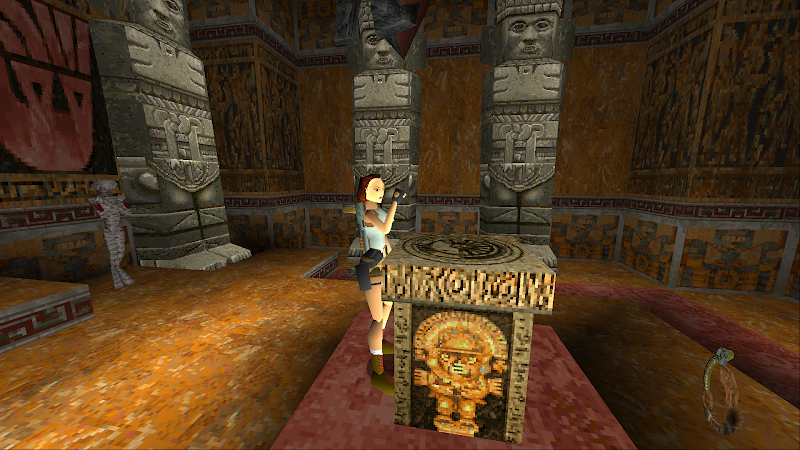
There are also a lot of Atlantians now, mummified vaguely humanoid creatures with exposed muscle and bone. By now you should be able to just shoot them with the magnums instead of Lara's default pistols. I hope so, because these guys are tedious to kill. They move fast in a circle, so you can't really use previous methods to dodge them. They move fast, so unless you know where they are ahead of time, you can't escape to a ledge. Even if you can, sometimes they shoot energy bolts at you. You can dodge those, but they are a pain to kill. Some fly, but these are usually less annoying to kill. Sadly from here on out you'll have to kill a lot of them. There are also panthers, but they're just reskinned lions, so they're not really new.
You end Egypt by killing Larson again, or maybe Lara somehow didn't kill him the first time, it doesn't really matter. Then we get a cutscene where Natla and her goons take the Scion off Lara as well as her weapons, but before Lara can be killed, she escapes. Then Lara sneaks onto Natla's boat and reaches the final levelset, Atlantis.

Natla's Mines is an interesting level. You start off without any weapons and gradually pick them up again over the course of the level, with her pistols being what the opening puzzles are all about. You're not really worrying about enemies, there are only three and only one is one you're likely to fight without working towards it. Here paying attention to everything is not really the way to find secrets as much as the only way to advance through the level, secrets instead are becoming quite difficult to find, almost impossible even. For instance, one of the puzzles you have to solve involves you reaching a hole before a boulder can, Lara isn't hurt by immobile boulders but they block her movement.
 |
This guy is weird, from being on a skateboard in a weird skateboard park to talking like Robert De Niro for some reason.
|
The three goons aren't terribly interesting as enemies, mostly they're a second source of weapons, possibly even the first time you can see some of them. They're like Larson and Pierre, except they run around a lot more. More interesting is a secret where you have to find places you can land on a big series of slopes.
Atlantis is where the game turns really dark. Now you're in some bizarre fleshy structure, like the inside of someone or Doom's hell levels. There are a lot of Atlantians around, but more importantly this is where the platforming really expects a lot out of you. Hope you've been paying attention, even to some of those secret areas, or you won't get very far here. Even though I find the Atlantians somewhat tedious to fight, it's a fine level, the constant background heartbeat and the environment really sell it.
In-between deadly traps and jumps, there's a sort of boss in a weird doppelganger. This is a puzzle boss, you can't shoot it because it shoots at you. Instead you have to get it to fall into a pit of lava. It's slightly clever, but as far as doppelgangers you can't fight and have to resort to trickery to defeat, this isn't that clever.
At the end, you find the Scion again, in a big cutscene you get a bunch of revelations. Natla is the third ruler of Atlantis, and they buried her because she misused the power of the Scion. To say she's psychotic is putting it mildly. She gives the usual manic speech to Lara before she tries to destroy the Scion, bringing us to...
The Great Pyramid. There are not one, but two bosses here. First you get a giant Atlantian. It's a damage sponge, keep shooting at it, hopefully with either the Uzis or the shotgun and eventually it'll die. It is very slow, and it has no ranged attack, so you're not really in any danger. Then more of that hard platforming Atlantis loves putting in front of you. Hope you like figuring out how to dodge a boulder with basically no spare space!
 |
That's not very interesting, so take a look at this unusual platforming exercise. There's something on the other side of the collapsible tile, but it takes a jump from there to reach.
|
Natla, meanwhile, is the final boss...and she's not really that impressive. She flies and she shoots at you, but by this point I had a ton of ammo and plenty of medikits and who cares about something shooting at you? Enemies running into you are worse. And that completes Tomb Raider. There's a lot more platforming I glossed over, but there's only so many times you can gush over that.
Graphically, this is carried by art direction rather than quality. It's very nice looking, but has a lot of problems. Animal models are goofy, and human models are...okay. The artists' talents clearly lie in making humans, both animations and the look of humans are far better than the animals. The animals sometimes even have human characteristics instead of animal ones. They can't even really do fur well. Lara could stand some refinement, but her animations are flawless.
Something that hasn't come up a lot here yet is texture alignment. That is, making it so one texture connects properly to the next. It's a very important job in 3D and even 2D games, but until now I haven't had much cause to complain. This is the first game I've blogged about that screws this up in a noticeable way. Worse still is how the game does textures quite badly regardless of whether they're properly aligned or not, textures shrink and expand in a way so noticeable that I haven't seen a professional game before or since.

I kind of dislike the CGI cutscenes. They don't really look any better than the in-game stuff and the animation quality takes a large nosedive here, feeling incredibly amateurish. How these two aspects are so vastly different, I'll never know.
The game really sells itself as an adventure where Lara is going through ancient tombs, because it really works. A subject like this needs a minimum of combat, especially with human enemies, as you're supposed to be going through places humans haven't tread in ages. By the time the game turns into a fight against ancient beings that really doesn't matter anymore, because it's made a smooth transition. Even those places still feel like some sort of ancient tomb, just with the original inhabitants being a bunch of psychotics with a hatred of the intruder, playing into the usual mummy curses.
While the story isn't impressive, I do think that it works really well with what it's supposed to be doing. Woman gets hired to find artifact, gets betrayed by employer, finds out employer was convicted for crimes against creation, kills employer twice. It doesn't overstay it's welcome and fits quite well in the Indiana Jones knock-off the story was going for. Also, gotta love the strong accents of the Americans and Brits, yet thte Frenchman sounds like he's phoning it in. Is this truly the nation that gave us 'Allo 'Allo?
Sound-wise, the music is nice, but often spoils combat by switching to a combat track long before you could expect to see an enemy. It works best when you have subtle background sounds, or the music becomes grand when you see some nice new room. The sounds themselves, despite being low-bit, are very satisfying, from guns feeling better than they are to shoot and the sounds of someone getting killed, be it Lara or something else, sounding sufficently crunchy. And that's all I have to say except for the summary.
Weapons:
There's not a lot to combat, but these weapons do feel satisfying to use. 3/10
Enemies:
There's some nice variety, but because combat isn't the most interesting, it feels somewhat wasted. 5/10
Non-Enemies:
None.
Levels:
Nearly flawless, possibly even too good in most places. I do think some cutting could be done at the end of Greece. 9/10
Player Agency:
Lara basically has two flaws, a lack of turning speed and a slightly awkward camera. 9/10
Interactivity:
While there isn't that much going on environmentally, what is going on is very well done. This game exploited the heck out of it's tools to the best of it's abilities. 6/10
Atmosphere:
I have never seen another game do abandoned tombs and cities so well. 10/10
Graphics:
Good art direction and animations, at least outside of the CGI cutscenes. A lot of texture issues though. 4/10
Story:
Simple but effective. 4/10
Sound/Music:
A few awkward triggers, but otherwise perfectly fitting everything. Noticeably low-bit rate though. 8/10
That's 58, or third/fourth highest rated game here. It's the same score I gave Doom 2, which will probably go a bit lower when I next reach it.
Reviews, a lot of positive stuff here. Frankly, so many just echo my sentiments it's hardly worth pointing out. Outliers are either reviewing the iOS version, which is not a fair comparison, or Famitsu, which I don't seem to find the full version of, and considering what I've heard about Famitsu, isn't going to be insightful anyway. Modern criticisms are mostly regulated to controls and graphics which I don't think we really need to go over again. There's also the realism argument, but in regards to this series, I can't help but think of this video.
On a more serious level, there's a point at which a game loses the fun it gains from making the game more interesting in the realism department, and making Tomb Raider any more realistic would go in that direction. Making combat more like ARMA would not make the game more fun. Making fall damage more realistic would be annoying, be it decreasing the height or making the damage worse. All the little things that makes real life differ from fiction, like insects, minor cuts and scratches, removing brush or dealing with the aftermath of wounds only work if you balance a game around it, and even so people don't generally like survival games outside of that niche. Games where you just eat don't count, and considering Tomb Raider that would be more busywork.
I decided to make some changes to what was being played. Firstly, I decided the way I was playing Star Fighter 3000 was going to produce an unbearably long entry and I was unwilling to restart it at this point, so out it went. It will be a regular game whenever I get to 1994. Regular selection of games will pop out in the new year. Until I fire up Elm Knight, we'll be seeing Commander Keen games. As someone pointed out to me that it might be a good idea to play Anniversary sequentially, which happened to line up with the game being discounted on Steam. Has some real "you know what I love after a workout? another workout." energy to it, but I would probably never get to it otherwise, so why not. I'm putting something between this and that though.
Anyway, a Merry Christmas and a Happy New Year to all my readers.




-0010.png)
-0110.png)
-0067.png)
-0208.png)
-0227.png)
-0489.png)
-0336.png)
-0079.png)
-0098.png)
-0430.png)
-0263.png)
-0437.png)
-0083.png)
-0358.png)
-0260.png)
-0394.png)
-0478.png)
-0116.png)
-0190.png)
-0184.png)
-0231.png)
-0465.png)
-0474.png)
-0493.png)
-0406.png)
-0331.png)
-0483.png)
-0101.png)
-0473.png)