Sunday, June 14, 2026
Overkill (1992)
Number:262
Year:1992
Publisher:Epic MegaGames
Developer:Tech-Noir
Genre:Shoot 'em Up
Difficulty:4/5
Time:1 hour
Won:Yes (116W/88L)
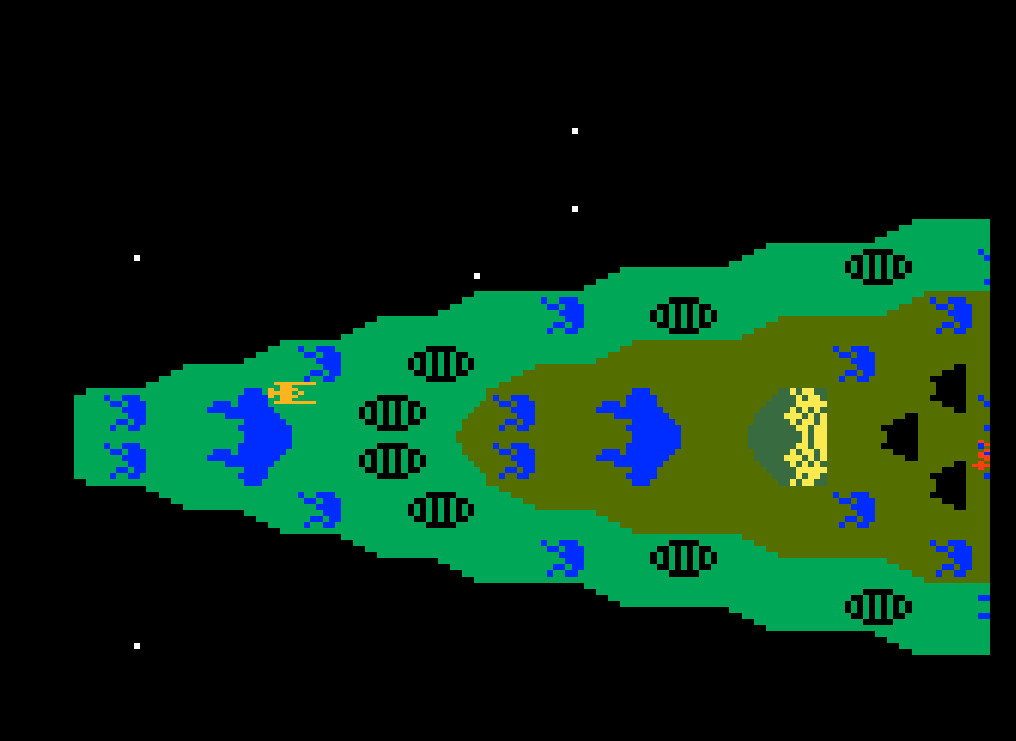
I do not care for shoot 'em ups in a broad sense. It seems to be that the genre tends to indulge in the worst part of hardcore Japanese design tendencies. Make it so that the only way you can ever beat the game is to replay it until you have everything more or less memorized. I realize that not everything in the genre is a bullet hell, but it does seem like most of the genre past the '80s indulge in this to some extent. The exceptions being a small window in time when for some reason Apogee and Epic both decided to publish games where instead of fishing for upgrades, you can just buy them.Unfortunately, this is neither Raptor nor Tyrian, so instead we're going to get ourselves a regular old shoot 'em up, this time on DOS. That title screen and this cool little picture that pops up if you wait are writing checks that the gameplay cannot possibly cash. Sure, they overuse dithering, but god that's rad as hell. That's the kind of picture that you use when your game's character is musing about his use of force in wrecking the Orion homeworld, not a game where you just shoot things until the game says you've won.
One of the strangest ways this differentiates itself from the competition is that it has music using a Roland MT-32. It's always a treat hearing this thing, but the actual music feels strangely out of place, and the sound is PC Speaker anyway. People mock Ultima Underworld for having piano footsteps, but it's better than spending hundreds for a high end piece of musical equipment only to get blips and bloops for laser shots.
The game was of course shareware, and came with one out of six planets. There are three difficulties, which mostly affect how fast enemies are and how much health you have. Since these stages are short and they need to pad this game out, this doesn't help you too much. There's no backstory in-game, but the accompanying text file explains that everyone else has been killed by psychotic and xenophobic aliens, so kill all of them. Okay, that does fit the opening images, even if there could be a bit more to it than that. Also, I'm not sure the music fits the theme, considering it sounds like the jaunty tune.Starting up the game and everything is quite mundane for a a shmup. It's vertical scrolling, which means a bit less playing area. Arrows move, and you move kind of slowly. Except diagonally, which is annoying. Ctrl shoots. These keys are all rebindable. Where it gets strange is with the equipment/upgrades. Tab activates your current number of upgrades. See that thing in the lower right? Well, for each upgrade package you pick up, you go one category lower on that side. (There are also health and fuel pickups, the later of which I'll explain at some point)While it seems like this system should be straight-forward, it isn't. It's quite esoteric and incomprehensible. I think it's designed like a pyramid, you need a certain amount of upgrades from a previous tier before you can get the next in the next tier...but that doesn't always seem to bear out. Sometimes you need more in a previous tier than you should need for the next. Sometimes you can get something from the later tiers without losing out on something with your basic weapon. There's nothing in-game explaining the system, the closest you get is a demo screen showing the various upgrades. You just have to remember which combinations might result in you wasting an upgrade.
The most basic upgrades are to the lasers. Which go from basic, to double/rapid fire, to diagonal, move left or right to shoot in that direction, works oddly, then go through laser. The double fire is actually the best option until you get some upgrades which give you various side bits to your fighter. A nose piece or side bots which increase your firepower. How these work is again, beyond me. Even the missiles I don't understand much beyond "get missile and missiles start firing".
One fun thing is that those two bits I just mentioned can get damaged instead of you, and then destroyed. The side bots are particularly interesting, because during the tighter sections, they're going to get damaged, and if one on one side gets destroyed, you start leaning towards the other. It's a nice touch despite being annoying.
There's also a fuel system, which at first isn't much of a concern. As you get upgrades though, it requires more and more to the point that you actually need to worry about it when you have more upgrades. This is primarily concerned with ship size, but it might be linked to how much you're firing at a time. Generally speaking, this isn't too much trouble, but be careful.Each stage goes along similar lines, even if there's some differences between them. Each starts with a quasi-Galaga set of enemies spawning in, which you have to kill, and you can theoretically stop before they all pop up if you kill the lead ship. Theoretically, because even if you have a bunch of upgraded weapons, they don't activate here and the lead ship is tough. It's a test of skill.
Not all sections in the middle are exact copies of one another in design and in order, but there's always a general type. Your basic corridor; The tight area where there are turrets on the wall you need special weapons to take out; The one where missiles get thrown at you from an area you can't shoot. Enemies too, in addition to the turrets and missile shooters, there are enemies which move around like a slinky, up and down; Ones which walk up and down the walls taking potshots at you; Random flying rocks; Enemies which shoot a million bullets at you; And regular enemy fighters.The end of each stage is usually some kind of asteroid field or group of enemies which go on for much longer than they should. Before you get any real power-ups, it's kind of nice. Having a pure dodging section makes me feel clever. Shmups are generally more about positioning than actually shooting things down, and having that feeling without having to dodge ten thousand things at once is nice.Stages are meant to be played in sequence, and picking a later one kind of feels like using a level select code. This sounds odd, I must admit, but compared to other games where 1 credit clearing is the ideal, this is one live clear as the hopeful standard. As you can imagine, the basic laser is quite useless against some of the later enemies, even in the first stage getting killed could put you in a bit of a death loop. Although that said, I tried for the true ending starting at the fifth stage, and I never had any actual trouble, so this could be me talking out of my butt.In all my plays of the game, nothing really sticks out to me in the stages beyond visual changes. Oh, this one has spikes shooting out of the walls and monsters you have to destroy three sections of. Well, that means more power-ups. Obviously there are more enemies on-screen as you go further, but for the most part, it kept up with the amount of damage I was outputting.The final level has a boss and it's okay. It's big, it moves around some, and I never had any trouble with it. It exists and I shot it down. Then the game seemingly ends the same way as the other levels, with the player entering the main ship and getting his stuff, but there is an ending. Are you kidding me? It loops? Is this one of those situations where it only counts if you beat the game on the highest difficulty? Well, I tried my hand at beating a second loop a couple of times, but I actually managed to get myself killed after a certain amount of upgrades. Not because I got killed, but because I ran out of fuel. Which is an instant game over. Since there isn't anything new in these replays that I can tell and I generally don't replay games which place their endings like this, this is where I end.
Weapons:
The gradual increase in firepower and number of upgrades are cool, but there's very little practical strategy to picking them out. Some upgrades hurt you, and sometimes you just have to hold onto the upgrades until later. 4
Enemies:
A nice selection of the usual sort of enemies you would expect, but nothing memorable. 3
Non-Enemies:
None.
Levels:
Were it not for different graphics I could scarsely tell the difference in level design. 2
Player Agency:
Very basic. You move a bit slower than I'd like, but considering how big you get, this is probably intentional. As usual with this genre, it annoys me that there's a firing rate difference between hammering the fire key and holding it down. What I'd really like is the option to just put my upgrades into a particular group instead of having it as one key. 4
Interactivity:
Anything that isn't trying to kill you somehow just doesn't really matter. 0
Atmosphere:
It's strange. The backstory says fighting back after a horrific genocide, everything else says jaunty space adventure. 3
Graphics:
Once again, I genuinely can't tell if this is EGA or VGA, though considering the massive amount of dithering, I lean towards the former. Either way, the variety between the stages works out, and because it's a space game, it doesn't matter that it doesn't have that much animation. 5
Story:
The backstory and the in-game ending seem somewhat at odds. If you're not going to bother, why contradict yourself? And if you're going to lazily copy names from better known franchises, why would you not throw in a Star Trek reference? 0
Sound/Music:
It's fine, but unmemorable. It strongly benefits from using a MT-32 for music. Otherwise, the sounds are PC Speaker, and by this point that's not acceptable. 4
That's 25.
It feels generous, it's more than Electro Man but less than Epic's other titles. I can also tell you right away that unless Major Stryker has some issue I'm not aware of, it's probably going to be the worst rated title out of all the DOS shmups from the shareware era. (That I'm inclined enough to play) As a shareware experience, this would have made me not inclined to buy it, and if I did, I would have felt robbed. There is a certain amount of me not being a fan of the genre, but at the same time, being me, I beat it in under an hour. Yes, there are harder options, but even that wouldn't last that much longer.
Oddly enough, Tech-Noir isn't just some in-house developer, it's an actual British coder, Ste Cork, who did the DOS ports of Obitus and Armour-Geddon. Technically, the company is just him, both of those games were developed by other people and the only other game the company is credited on doesn't involve anyone else from this game. These days, he works for Raven Software, being one of the thousands who work in the Call of Duty mines. Oddly, he's been there since 2000, starting with Soldier of Fortune. Which is quite impressive given the scores of developers who seem to be constantly let go after games are released in AAA studios.
Next time is Spear of Destiny - Ultimate Challenge, because I might as well get it over with.
Sunday, August 17, 2025
Strontium Dog and the Death Gauntlet (1984)
![]() |
| Nothing screams Strontium Dog like whatever this is. |
Number:242
Year:1984
Publisher:Quicksilva
Developer:Argus Press Software
Genre:Shoot 'em Up
Difficulty:2/5
Time:40 minutes
Won:Yes (107W/77L)
The last Strontium Dog game was interesting, but absurdly difficult. Undoubtedly suffering for being an action game on the ZX Spectrum. So, what does the broadly superior C64 game do? It's a shoot 'em up. Only, it kind of isn't. It's an endless runner, sort of.
The story, as told by a pirate intro, is that our hero, Johnny Alpha, crash landed on a planet full of renegades (bad guys, presumably) while being pursued by the Stix Brothers. Run until Johnny gets to the ship where his partners are waiting. The death gauntlet of the title is him just walking across the desert to survive.
This, in contrast to the last game, is not based on any story, but just uses characters. The Stix Brothers, which is actually an entire family, are a group of mutants who all look and dress the same way. Very convenient for a video game adaptation.The controls are weird if you don't play them on an emulator. Basically, space shoots and the joystick moves. What makes this really weird is that because I'm generally emulating my joystick, space is the joystick button. A whole lot of effort just to get back where it all started. Function keys deploy a timebomb, which sends you forward. I never really had need of it.At first, the game is insanely confusing, bordering on insane. Randomly running into things, not understanding why you've suddenly died, and things just happening. There's very little visual clarity, the most detailed objects on-screen are Johnny and random rocks. Everything else is somewhat detailed but one bit. It's odd, visually.Very quickly, things become clear. The first part is that the game runs weirdly. Up and down move up and down, but left and right control your speed. This is different from plain old moving left and right. No, going faster depletes your strength, while going slowly allows it to slowly restore. Oddly, when you move very slowly, it's basically impossible for any significant amount of damage to happen.
When Johnny inevitably crashes into something or gets shot, he loses a life and starts flailing around on the ground like he's screaming about life not being fair. The other game didn't exactly put a big mental image of the guy in my mind, but at least I can attribute that one down to forced choices. This just feels like it's mocking the guy while he's down.The inevitability of getting knocked down and how low amount of damage and quick regeneration actually creates a weird effect. It's not quite an endless loop, but it comes off as something where you have to put in very little effort to play. It's almost like the player is useless in the equation. There are powerups scattered around which increase strength, but why break what's a winning strategy?
This creates a weird loop. Playing it as slowly as possible is fairly simple to play, but it isn't very fun. Speeding it up kind of makes it interesting, but adds in danger. The thing is, I never quite figured out why one form of injury resulted in Johnny's death and another just resulted in him flailing around for a bit.
While it is difficult to fully avoid getting knocked down, individual pieces of scenery are easy to dodge. Johnny's hitbox is just his feet and all the scenery is surprisingly small. It's very generous, the game just throws a lot at you. That, along with the enemies is what gives the challenge, such as it is.
Enemies too, have a hitbox that seems to just be their feet. While this makings dodging most a cinch, it also makes hitting them trick. You only get one shot on-screen and most duck and weave enough that hitting them is rare. The ones you're most likely to hit are the ones that are most likely to cause you trouble if you don't, ones that slowly move to where Johnny is.After a while, they start shooting back. It's not difficult to avoid. I never got shot once and I wasn't exactly putting 100% in at that point. All of the shooting in this game felt superficial. It's there because it's supposed to be there. I think the cracked version I played had an issue with the infinite ammo cheat, because I suspect ammo was supposed to drop down at one point and it never did. It didn't really matter that much, but it might have affected things a little bit.
As you gradually move through the area, scenery begins to change. This is the only obvious indication that you're moving. Yes, there's a bar at the bottom that shows how much progress you're making, but it uses white to show where you are. In case you haven't noticed, there are parts of the bar that are white. Which means you can't see precisely where you are.
That said, visually, most of the later screens are uglier than the earlier ones. The rocks looked nice, the trees less so, and then it seems like it degenerates into random pixels. I guess it's a ruined city, but it sure seems like it's a lot more ruined than the worst bombs designed by man could ever do.
At the end, the game stops, two figures pop up. Is this a boss fight? No, I've won. The game ends with two figures popping up and then the game just loops. If I'm charitable, my winning playthrough took a half an hour. Which is kind of embarassing, even in this era, since there's basically no point to replaying it since it wasn't fun the first time. To the rating.
Weapons:
Your basic blaster, the time bomb isn't really a weapon. 1/10
Enemies:
A mass of vaguely humanoid and robotic creatures with some variation in behavior. 2/10
Non-Enemies:
None.
Levels:
Rocks and tress slowly move towards you. 1/10
Player Agency:
Very smooth and easy to understand as far as movement goes. 5/10
Interactivity:
None.
Atmosphere:
Nothing positive. 0/10
Graphics:
Detailed, but as a whole, feels unfocused. Johnny has considerable animation, but feels oddly smooth for the action around him. 2/10
Story:
None.
Sound/Music:
Blips and bloops. 1/10
Just going to subtract 2 points before finalizing for a total of 10.
There's no going around it, this game is bad. I try to see the good in creative matters, but no, this game is just bad. The kind of bad where you question why the developers chose to pick a creative field and charge money for the end result. Which usually is something we all ignore, but tends to hit harder in licensed media, because this is a character people like getting turned into a joke.
Next time I'll pull out something a bit off beat in Obitus, a game which is of many genres and nobody can quite agree on which one it truly is.
Wednesday, November 9, 2022
The Dreadnought Factor (1983)
![]() |
| Speaking as someone who has fond memories of the system, I can't get over how drab these title screens are |
Number:152
Year:1983
Publisher:Activision
Developer:Cheshire Engineering
Genre:Shoot 'em up
Difficulty:4/5
Time:2 hours
Won:Yes (52W/52L)
A fleet of the most powerful ships in the galaxy are coming after your home planet, and you need to shoot them all down before they oblierate it. From this simple premise comes one of the more interesting Atari-era titles, and one that actually comes across on-screen rather than just in a text. When I say shoot down those ships, I don't mean like your average game, gunning down individual ships. No, I mean capital ships. You take down a series of capital ships.
![]() |
| The very beginning of the first difficult, those blue things are how many other ships I have, you better believe you can run out |
At the start of every game, one of your ships sets out from your planet to initiate an attack run on the enemy dreadnought. The game is incredibly generous with the number of ships you start with on most difficulties. Each one functions as a life and you start the game with ten of them. On difficulties up to 4, you gain 2 per dreadnought destroyed, with difficulty 4+ having 5 dreadnoughts. On the higher difficulties, you get 4 per destroyed dreadnought. You're more likely to run out of time rather than ships, but you'll still need all those lives.
![]() |
| An empty space. There's a surprising lot of this |
![]() |
| A dreadnought with a good mix of destroyed and not destroyed equipment |
Your targets, or at least the equipment on the ship that doesn't actually shoot at you consist of vents, take out all 16 and you destroy the ship. The planet destroying missile silos, take out all five and you can pass by the ship to your heart's content. The engines, all four, take them out to give yourself time. This stuff is what you take out with bombs, all black and red. You can't shoot things you're supposed to bomb or vice versa.
Once you've made your first pass, the enemy dreadnought gets closer, supposedly for a set distance, but it always seemed to me to be faster than that. If you survived, you quickly start another attack run, otherwise a new ship starts its attack run. I'm not entirely clear on how the countdown mechanics work in this game. The way the manual describes it is a very straightforward "no matter how much time you spend fighting, this time is all that happens" while the game itself seems to be shorter than that. Either way, runs continue until you take out the dreadnought or it reaches your planet.
Eventually, should you manage to take them all out, victory.
![]() |
| The hole in center configuration |
![]() |
| A different shot of the hole in center configuration |
![]() |
| The narrow ship configuration |
Difficulty 4, or Advanced was as far as I could reasonably play. Medium, as far as there is a medium, is difficulty 3. I went as far as using save states to keep my progress, and to slightly lower the difficulty. Even with this later difficulties come off as a bit tedious to actually finish.
Playing this was considerably more interesting than I'm used to from games of this era. Rather than vague shapes fighting against other vague shapes, this had very defined concepts that actually worked. It feels like we're getting to the kind of games that show the formation of ideas that would be expanded upon years later. This in my mind plays like a very rough first draft of the space combat in Star Wars: Battlefront 2. While I did like it, its hard to ignore that it was incredibly frustrating to play on anything higher than 4, even with save states.
Weapons:
The low amount of attacks you can have at once makes the consideration of what you should do in that moment very interesting. Take out a vent or shoot another turret? 2/10
Enemies:
I liked them, its a rare case of doing enemies gradually improving well. You start off fighting a ship that doesn't do much before eventually becoming a potent foe. Really, they did about as well as they could have done considering the era. 4/10
Non-Enemies:
None.
Levels:
An interesting variety of ships, each of which require a different strategy to take down. Yes, they definitely got some mileage out of their limitations here. 3/10
Player Agency:
While there is a learning curve, once I got the hang of things the ship controlled beautifully. I just don't care for the weird way I had to move up and down, which carried momentum to a degree I didn't care for. 4/10
Interactivity:
Its kind of hard to say there's much, since everything is an enemy, but the game does allow you to destroy everything in sight. 1/10
Atmosphere:
A pretty good attempt at putting forth the feeling of taking out hordes of capital ships, and the panic of preventing your home planet from being destroyed. 5/10
Graphics:
I'm impressed they got this much stuff on-screen, moving smoothly at the time. Its all easily distinguishable too. 2/10
Story:
None.
Sound/Music:
Your typical Intellivision sounds, nothing special. 1/10
That's 22. I feel a bit generous, so one more point and 23. That makes it the highest rate game chronologically, even without the boost.
Most reviews, which are in retrospect like my own, are similarly positive. Even IGN. Jesus Christ, I agree with IGN. Curiously, the only negative review, for the Atari 5200 version I didn't play, describes the game as tedious and a pain to control. This seems to be an issue exclusively with the Atari 5200 version, as the same reviewer talked about the Intellivision version much more positively some twenty years later. Something it seems the reviewer didn't even notice...
It remains to be seen if this title will get dethroned from status as best game of 1983. I know of a few contenders, but its hard to tell if they'll live up to the hype, especially at this stage where promising games frequently end up being disappointing.
Tuesday, April 13, 2021
Game 57: P47 Thunderbolt
Number:57
Year:1988
Publisher:Firebird Software
Developer:Nihon Micom Kaihatsu
Genre:Shoot 'em up
Difficulty:4/5
Time:1 hour
There's something ironic about a WWII game made by the Japanese where you play as an American. Its not the first time that happened, I do believe. 1942 I do believe was first by a considerable margin. I realize this whole thing represents a massive departure from what I usually rate, but I needed something different after Monster Manor and thus I was randomly looking through Amiga games.It doesn't seem like there's a story, so all I have to do is kill. And boy howdy, do the enemy make that hard for you. It honestly seems standard form to me. Enemies on the ground, helicopters...wait...helicopters? Eh, anyway. Big planes, small planes, and the one boss I reached was a train with a bunch of turrets on it. Touching enemies kills you, and you're a one-hit wonder in general. Another reason why I don't care for shmups. A combination of enemy formations and bullets from the ground make it feel to me, anyway, like I have to dodge too much crap. Which honestly just reminds me negatively of bullet hell games.
The movement doesn't help, I feel like I'm moving underwater. It takes multiple seconds to get anywhere, which feels a bit strange in a genre where such things are important. Holding down the fire button works fine...for bullets, but there are special weapons, and those don't go off if you hold the button down. In a game where there's no benefit to not holding a button down, I'm curious as to the logic of it.
Weapons:
You have the regular gun, and a series of special weapons. Missiles, bombs, and a kind of chaff cannon that kills things. Getting more powerups gives you more power. 3/10
Enemies:
A nice variety of planes, ground vehicles and turrets. 2/10
Non-Enemies:
None.
Levels:
It doesn't really drag me away from my usual opinion of shmups, that there's nothing really interesting going on. Although I did only reach the second level. 1/10
Player Agency:
The plane moves awfully slow, which makes my job of evading enemy fire difficult. Too difficult than I care for. I'd also like an autofire button, just holding the fire button down does nothing for my special weapons. 2/10
Interactivity:
None.
Atmosphere:
A pleasant flight through the countryside. 3/10
Graphics:
Pleasing, but not impressive. 2/10
Story:
None.
Sound/Music:
Decent music, the kind that's pleasant, but you couldn't name the tune of ten seconds later. No real sound beyond that. 2/10
That's 15. I'm probably wrong, I'm not an expert on the subject of shoot 'em ups. Soon enough I'll return to something I get proper enjoyment from.