Showing posts with label Space Simulation. Show all posts

Sunday, August 16, 2026

Elite (1991, Acorn Archimedes)

Name:Elite
Number:267
Year:1991
Publisher:Hybrid Technology
Developer:Hybrid Technology
Genre:Space Simulation
Systems:Acorn Archimedes
Country of Origin:UK
Difficulty:5/5
Time:8 hours 10 minutes
Won:No (118W/92L)

The original space trading simulation, at least as far as British audiences are concerned, on the best possible system for it. A large, technical marvel which has eight galaxies to explore each with a couple hundred planets. A whole universe for one to play around in, just as soon as you can figure out how to dock with a space station.

Elite
is one of the legendary '80s games, so popular within a certain section of the industry that its influence can be felt outside any genre it touches. A game so popular at the time, that one copy of it was sold for every BBC Micro, an impression task considering that the system was intended to be a classroom computer, and it really isn't that educational. And I still don't like it after trying to actually make it work.

Take away every important factor about the game and what are you left with? A space simulation that doesn't work like any other space simulation in a significant number of respects, and with gameplay depth that really doesn't warrant going past those. There are what, two, maybe three other games that use the same control systems this does? The freeware remake of this, and two of the sequels. I'm assuming that Elite: Dangerous is using a different control system.

In contrast to just about every space sim I've played, left and right don't turn left or right, they rotate left or right. This makes it so that you really only move when you go up or down, with your rotation determining which direction is up or down. There are a lot of games which also have rotation, but the difference is that these usually also have turning or they're halfway between rotation and turning. That this is the only thing I can do is where the objection lies.
The thing about space flight in comparison to ground flight is that there really isn't anything like aerodynamics to worry about. Space ships will keep moving until something stops their speed, barring sci-fi technologies like FTL drives. It makes sense that ships would have small engines to adjust their rotation, because otherwise they could come into a space station upside down. But it also makes sense that they would have the ability to go left or right, since that makes space flight easier.
Elite doesn't do rotation for any realistic reason. It's still as arcade-styled as any other space sim of the era. Your speed is not tied to anything real, it's tied to how fast your engine is going. Turn your engine down and you go slower. It's doing it so that it can add in a tricky situation where you dock with a rotating space station.

Docking with the space station is arguably the game's greatest challenge. You have to match your ship's rotation to the hanger just as you enter it. For many, this is where they quit. After several hours of sometimes making it in, I have to say that the quality of this is overhyped. Yes, it's challenging, but that's because you can only rotate and go up or down. It doesn't really work with the player's view, instead the player's view seems to be slightly above the point he needs to enter the hanger.

And honestly? This hides that the rest of the game really doesn't have that much going for it. Yes, there might have been something to the combat in 1984, but, as much as I hate to say it, it isn't really doing anything over any popular later space sim. At no point was I really able to use much strategy. If I could run away it was because someone wasn't chasing me. Otherwise, I would just do my trip from the jump point to the space station, chasing after any hostiles that shot first. Yes, I could shoot someone chasing me...but do you want to try that with reversed controls for this game?

Of course, there might be weapons I'm missing since I didn't cheat to get any of that. I got fuel scoops, a docking computer and more powerful lasers. Of these, I noticed that the fuel scoops were most useful, since they could pick up discarded cargo. Could, since more often than not I crashed into what I was trying to grab. Yeah, turns out even when you're chasing after an object heading in one direction at a set speed that trying to catch it can be tricky. It also catches fuel when you go near the sun. If you don't want to pay 2 credits and want to go through like ten minutes and five groups of enemies.

I should also point out that there's illegal cargo in this game, which if you buy or sell, causes you to become a criminal. I also never found the cargo jettison function, if there is one, which means that if you pick up narcotics with your fuel scoops, I hope you enjoy becoming the space police's most wanted or keeping it in your cargo hold forever.

This sort of leads into the problem with Elite, it's impressive what it can do, but it often feels like it's missing something important. Yes, it's very cool that there are eight galaxies with 256 planets each, but every planet of the same type is much the same as every other planet of the same type. There is nothing special about any random planet in the universe. There is at most, a handful of missions that involve a particular planet, which you need to destroy a lot of ships to reach.

And this is the expanded version, which is supposed to be the best of all possible Elite versions. I'm not sure the exact list of improvements, but better graphics, missions and are the noticeable aspects. The AI most noticeable of all. I'm not actually sure how smart it is, but the game, in comparison to how it was before and likely a number of its 1991 contemporaries, has a lot of ships at one time.

The breadth of the types of ships you can encounter is something that seems wasted here. Sometimes there are singular ships flying by as you make your trip to the space station. They fly by and nothing happens. Sometimes there's a ship destroying asteroids. Other times, there are large groups of ships. Usually pirates, but shooting first might result in you accidentally killing a group of unaligned traders. Hope you enjoy getting shot by the space police.

But none of these ships really matter that much in the here and now. Sure, there are probably a thousand different configurations going on, but if the two of you pass by, does it really matter? Does it matter what configuration a pirate ship has? If it's one or a half a dozen, it's not like they're going to have a radically different setup. I never had an enemy use ECM measures against my missiles. Of course, I rarely got them off, but someone should have had it.

The real problem with combat is that halfway through a battle, it's entirely possible for a second group of pirates to come in, decide that you and you alone should be killed. In theory, you can also come across a group of space police coming in at the last minute or a battle between pirates and the space police. It's a nice touch, even if it always results in me dying. It was the one time the game actually felt alive rather than me doing a bunch of stuff I was allowed to. 
I have really been overselling how much this game has going on, because most of the time, nothing is. You leave one space station, select a destination star, usually which has favorable prices on a trade good you just picked up, travel to the jump point, and then take a five minute trip to that space station, where you'll dock. If you can that is. There are maybe three encounters on this trip, and while frequently there will be one pirate encounter, it isn't a guarantee.

Instead, this is basically an excuse to sit back, and listen to music. The sound mixing is going to be crap unless you listen to classical. I mean, you could listen to Creeper or something, but "pop" music, in the non-classical sense, is mixed so that you'll never hear the sounds of the game over it. (Anything that involves spoken word is going to be tricky, the second something interesting happens, you'll be ignoring it) Classical just works better with it, and I'm not just saying that because I needed an excuse to listen to some.

While I never realized it at the time, most of what I was actually doing was...space trucking. I was a space trucker. You know, like a less glamorous version of the people from Alien...and without the interesting things happening to them. I'm just a dude transporting furs to one planet and computers to the other for a small bit of profit, listening to the radio so I don't nod off.

In that sense, I could recommend it...Except that this week, I didn't have power for a while. This would normally not be relevant, except that the part that was the most interesting, flying between stars while listening to classical, can be done a number of other ways. Like sitting in the dark, listening to a classical station because you don't have any other option. Actually, I'd recommend it, because something about it feels more powerful in that situation.

Which means that the most interesting part of this game...kind of is completely outclassed by just turning off all your lights and then listening to music without any distractions. Pirates probably aren't going to break into your house halfway through a piano concerto. The space police aren't going to be upset with you for listening to a small piece of a Wagner opera.

There are a lot of systems in this game which I feel like I've only scratched the surface of, but they weren't that important in the eight hours I played of the game. That leaves space trucking and pirate hunting, which you do just to do because there's barely anything else to do in the game. So many things about the game are clever...and yet none of it truly matters when there's a whole lot of nothing out there to do beyond it.

Weapons:
Lasers you can install forward, backward and sideways, along with missiles and possibly other things which are too expensive and clunky to use in the heat of most battles. 2

Enemies:
A decent variety, albeit because of the mechanics of the way the game works, are hard to distinguish between one and another, outside of obvious outliers like aliens. 3

Non-Enemies:

An impressive array, even if it seemed like the only ones I ever encountered were either people I passed by or those who soon became enemies. 3

Levels:
Eight galaxies of a lot of stars of some limited number of types. They're not very interesting. 1

Player Agency:

The controls were a bit too loose for me. It felt like a struggle to just right my ship, let alone chase after someone. Of course, being an Archimedes title, the mouse and its three buttons are used to the fullest, but I did get used to adjusting speed with the mouse buttons. Launching a missile feels too involved. 3

Interactivity:

If you have the right attachment and ram the right things, you get stuff. If you don't, you crash. 0

Atmosphere:
Nothing quite like being a space trucker in the absolute emptiness that is space. This must be the Total Perspective Vortex I've heard so much about. 3

Graphics:
Filled polygon 3D. Crude, but often there are clever effects going on, like suns doing that line thing, and planets having dots move across them. You can actually feel the 3D space with it. 3

Story:
There was a novella distributed with the game, but this is just flavor. Arguably, this did a lot to enhance the game's mystique and by not reading it, I've ruined the game. 0

Sound/Music:

Useful, but not particularly memorable. No music, but considering this has a reasonable playtime of a hundred hours, this is appreciated. 3

That's 21. Not particularly special for 1991, but pretty high up for 1984.

Yes, there was something to this and what it did was incredible, especially on a system which wasn't that powerful, but there's not really that much to it beyond the surface level. Yes, there are missions and eventually you can get to some huge ranking by killing a ton of pirates, but man, there's not a lot to fill that massive amount of time you'll spend getting to those points. It doesn't matter how clever you make a game if there isn't that much going on in the short term.many clever little touches you add if there's not that much to actually do.

I'm slightly altering up my plans going forward. A lot of vehicle simulations, basically all from this time, are nearly indistinguishable from a FPS game, so I've decided to add a focus on those. Which means we're about...60 games away from finishing the early '90s FPS part of the program. Depending on how these feel, I may just take these as an alternative to playing whatever I have left from 1984. Next time though, Star Cruiser on Sharp X68000, or whichever release has the English translation.

Sunday, June 28, 2026

Quest of the Space Beagle (1984)

Name:Quest of the Space Beagle
Number:263
Year:1984
Publisher:Avalon Hill
Developer:Scott Lamb
Genre:Space Simulation
Systems:Atari 8-bit, Commodore 64
Country of Origin:USA
Difficulty:5/5
Time:1 hour 50 minutes
Won:No (116W/89L)

The Continuing Adventures of Jupiter Mission 1999, Part II is a subtitle that really should have been looked at by an editor. The title is a pain to screenshot, it's flashing. Good thing I don't have epilepsy. In case you don't feel like going back, Jupiter Mission 1999 was about the player being randomly selected to go on a mission to Jupiter, where there was a mysterious signal. All the competent people die in an asteroid shower, and the player is forced to do the work because the sentient AI in control of the ship got damaged. I left as the game crashed after trying to figure out how to move my ship.
Explaining what happened is now a text crawl with moody music in the background. Also flashing, lovely. So the part I didn't get to was stopping an alien invasion, which I did by activating a self-destruct switch on the alien's teleport station. It exploded and teleported us to a far galaxy. Where all the aliens were that wanted to conquer the Earth...only for one that approached me to be friendly. Uh, I think we might have made a boo-boo. These are the Faunians, descendants of a great civilization from eons past. They were heading for our system not because they were conquering the universe, but because hostiles, The Gentuza, were heading after their homeworld. Now I have to help. Because the Faunians, being gentle herbivores, are unable to fight. They're not descended from hippos, I guess.
The first section is a epic space battle between these forces, with you on the Faunians and the Gentuza being your target. This is their homeworld, incidentally, so we're starting out small. You have to take out their fleet and then capture the planet. Like an on the ground view of your typical Master of Orion or Galactic Civilizations game. All you have to do is individually take out every ship yourself. Have fun! Given how the last game went, I'm sure you're about to ask how bad this gets. 
Pretty bad. Simply put, enemy ships can move faster than you, and you can do nothing about that. Their shots only hit you when they're on-screen, and sometimes you can get them off-screen, other times they stick like they're already attached to you. Even in my first attempt it wasn't completely unreasonable to take one out, but it was very frustrating to do so. Still, sometimes I get lucky. Even worse, any time you get hit, you can't fire for a few seconds.

So, one time after I died, I counted how many ships were left. 32, out of what I believe is 39. (It's actually 40) Considering these guys are only inferior to the player in that they die after one shot, this is quite unbalanced against the player. Fighting against a superior number of enemies equal to your strength is not something I've encountered in any space sim I've played before. Yes, there could be a number of hostiles superior to you, but not to this degree. More grinding. There are probably a whole bunch of complicated rules to this I could possibly learn the entirety of, but I understand enough to get away from all the shots except the ones the game decides I can't.
After savescumming my way through that mess...nothing happens. Right, well, there is a strange thing on my M-scan. Which if it isn't showing up on my screenshots, is an orb on the lower right, compared to the V-scan on the lower left which shows the enemy. Clearly, I need to head to it, despite no visual on-screen. So I finally check the manual. It does explain the combat system slightly better than I previously understood, but doesn't actually explain how I'm supposed to go forward beyond heading for 000,000. Which I have no way of figuring out because the part of the GUI which has that pops up when I'm damaged, not when I'm perfectly okay. Oh, and I love this line from the manual:

IMPORTANT: Save your game frequently to prevent an undue amount of repetitive play.

The game is actually telling me to savescum. That's hilarious. Eventually, I figure out how to summon the GUI, F5, and head for the planet. It's when the blue dot is in the center of the scanner. Now I have to...wait, I guess. First time I've played a game that requires the manual to understand but it also forgets to mention half the important information. After I go off for a bit and then return...it still hasn't advanced, but after jiggling the nose a bit it works. 

I'm not writing all that down, but hopefully you get the message. Since I crushed their space navy, they consider me the strongest, but before they'll do something for me, they want me to prove myself in their labyrinth. After some trouble getting it to load, I reach the next part.

Hope you weren't reading something to pass the time, because you're on a timer. Oxygen's running out, you're going to die! Gotta say, I can't imagine having spent money and all that time on this only to end up in a slow section where you slowly walk around. Hope you read the part where the fire button moves your camera around, otherwise you'll be slowly crawling into whatever hazards are about to kill you.
 
Oh, I'm sorry, that isn't working in this port, guess I'll just watch as this thing slowly creeps up on me and drains my energy. Or it might be, it just takes me a long time to figure out how the heck it works. It only works if you hold it down as you move, which I guess makes sense. It sounds like I'm angry, but this is just annoying and tedious. You move slowly left and right, but go up or down, or dare I say it, diagonally, and you take one step at a time. The complete animation for one step. Nothing screams fun afternoon like having to navigate some annoying hellmaze. None of this layout is fun or intuitive to navigate.

There are oxygen and food pick-ups, but the actual objectives are the computers. That big thing in the first screenshot. There are three of them. One was easy to find, but the way to it involved going over a pit. As I don't have a jetpack and there's no other way, I pressed on. After a considerable amount of searching, I found the second, which just resulted in me messing with some levers. Cool, cool. Going further in the section this was found just resulted in dead ends. So...did that spawn a bridge earlier? No. Well, I tried, but between the slow movement speed and how it feels like everything I'm doing is pointless, this is where I'm stopping in this game. After this, there's supposed to be a section where you find a path to Earth via star charts. Yeah, that's going to be fun.

Weapons:
A basic laser, even if there were quirks to how it worked. 1

Enemies:
The two different mini-games I played each had their own opponents, but both were quite basic, even if their AI was fine-tuned to annoy the player. 1

Non-Enemies:
None, really.

Levels:
Take down 40 enemy fighters and endless confusing labyrinth are not my ideas of a good time. 1

Player Agency:
Everything is oddly slow, though with exception to the whole "hold down the fire button to move the camera" thing, it works as intended. 3

Interactivity:
None.

Atmosphere:
This is such a strange and alien feeling game, probably why I stuck with it despite essentially being a modern action-adventure game which forced all the different sections into one big chunk of each rather than naturally flowing over the course of a longer game. 3

Graphics:
Simple, with decent enough animation whenever a human character is on-screen. 2

Story:
The evil aliens are going to fold because you shot down their defense fleet, but first you need to traverse their labyrinth is not interesting, but at least the writing quality is tolerable. 2

Sound/Music:
Simple intro theme, then...uh...I was actually listening to other music for a lot of the gameplay, but I believe it was mostly blips and bloops. 1

That's 14, exactly the same score as Jupiter Mission 1999. Makes as much sense as anything.

In a sense, this reminds me of later action/adventure hybrids like Inca. There's a world here that because of the nature of how it's made, we're not going to see much of it, so we're just left gazing at what is mostly a mediocre action game in an attempt to see the real meat. Everything else that's going on. As I said, in a sense, Inca's a lot better even if that's a game you don't care for and this is far more grounded in reality.

Next time, you know how a lot of people were doing touching and tasteful tributes to Bobby Prince last week? Talking about his contributions to amazing games like Commander Keen in Goodbye Galaxy, Doom, Duke Nukem 3D, Wolfenstein 3D and I personally hope, Bio Menace. Well, I'm going to talk about Pickle Wars, a game I remember being a male cowpie. Hopefully his contribution to that game is much better than I remember the game being.

Sunday, May 31, 2026

Jupiter Mission 1999 (1983)

Name:Jupiter Mission 1999
Number:261
Year:1984
Publisher:Avalon Hill
Developer:Scott Lamb
Genre:Space Simulation
Systems:Atari 8-bit, Commodore 64
Country of Origin:USA
Difficulty:5/5
Time:1 hour
Won:No (115W/88L)

Avalon Hill is one of the stranger publishers I've covered games from. It's been a million years ago since Voyager I as one of the first FPS games, and most of their oveure have been very strange. Especially since Avalon Hill is the computer arm of a board game publisher. That they keep coming up is just so odd to me. Here we have a space simulation, multi-game adventure. At least, this is how it's been described to me.

The game was released on the Atari 8-bit range and Commodore 64. Both are very unwieldy to play. I'm not good enough at Atari BASIC to figure out the former and the C64 version has a lot of loading. A lot. I hope I'm getting the authentic experience and not the sped up version, because otherwise, I really wonder how this sold anything at all back in the day. 

Shockingly, unlike most games from this era, not only is the story in-game, it's more than you get in the freaking manual. Not quite a wall of text, but dozens of pages of four lines of text. It isn't an improvement. It's a small story detailing how I was awakened one cold night to more or less shanghaied by government agents to a space port. I've been selected to go on a manned space mission to Jupiter. As in, the moment we arrive, they're injecting me with stuff and handing me manuals for space flight. Which is at odds with the cheery tone the game's prose takes, because this seems less triumphant rando gets the chance of a lifetime and more random schmuck gets used as a guinea pig.

The ship the game will be on, the Space Beagle, has an artificial intelligence of some fancy, schmancy classification which I'm sure I'll remember two minutes after I stop typing. The important thing is, it's a true AI, which I would think would be the bigger step forward compared to going to Jupiter. There are two other people on the ship, the commander, along with the navigator/engineer.

Now, the game doesn't start yet, because the trip to Jupiter takes place in the prose. Instead, we get the backstory of why this trip is happening. A strange signal was received back in '97, one that was obviously sent by intelligent life. Not from some faraway star, but from Jupiter. Two of the best astronauts would be sent along with some rando, which feeds back into game feeling at odds with what's actually happening. Because I'm being told this by the AI, who could either be told a lie to keep it docile, or it could be lying to me because it doesn't want to spook me. Considering that I'm supposed to be a wildcard and the success of the mission might hinge based on my reactions, it feels like someone isn't being completely honest. 
Finally, we get some gameplay. The ship is rocked by explosions, because we're in an asteroid shower. The initial attack was so damaging that it killed the two astronauts and destroyed the Beagle's command circuits. I have to do manual control. Manually control the ship's defenses to prevent further asteroid hits. I'm reasonably certain there's nothing in the solar system like this, except if the ship is deliberately trying to kill us. You could have altered our course a million miles back so we don't get smashed to pieces. Fuel is at a premium, but dying isn't going to help our mission.
This works like most Missile Command style games, except there's only one missile spawning in at a time. Oh, and you sort of shoot missiles back. It's a giant asterisk, so it might be a plasma blast. Lead your target, and shoot them down. Survive long enough for the ship to get out. Sounds easy, right? Right? Right? Right!?

I hope you went to the rest room before playing this section, because when I completed the section, there were 91 meteors. The second time I played this as a test, I was wondering what the hell was going on by the 30th. How long do you plan on sitting in the middle of a meteor shower, Beagle? You said command circuits were disabled, not that the ship was lying dead in space. Are you trying to kill me Beagle?

Because merely being tedious and long wouldn't be enough, the whole experience is difficult too. Aiming the cursor is as fun as any joystick aiming exercise. Which is to say, it isn't. Whatever, some games can make it work. Except that the cursor is inaccurate and the way your blasts arc is...well, you see that dot at the bottom? That's your gun. Shots come from that and there are multiple places where shots don't work the way they should work. Worst of all, the hitboxes of your shots and the asteroids are confusing and difficult to understand. I've seen multiple shots just fly past an asteroid.
After abusing save states and finally making it through, the Beagle congratulates me for somehow managing to survive. I took two meteors, less because I wanted to and more because I just couldn't kill them/suspected I needed some damage for the next section. (No one is getting through this without getting hit, no one) Because his command circuits are damaged, I now need to manually select which sections the robots will repair.
This is slow work, but at least at this point, you can save. Slowly move your cursor to the right, repairing any systems that were damaged. At first this seems simple, but no, it's a very bizarre mini-game where you have to match colors. You selection one color to match to the primary flashing color which...doesn't actually make sense since the colors aren't flashing, they're changing. Which one's the primary color. The keys in this section are not quite registering, so I really don't know what it is I'm doing here.

To help, the game issues a series of tones, which tell you roughly how long you have before you either win or lose at this particular mini-game. It's very annoying. Very, very annoying. It's not the worst thing I've heard or the worst thing I've played, but it is aggravating. As I tried to figure the game out, the only thing that seemed to happen was the sound slowly getting higher and higher. The sounds seem to be roughly tied into the colors, but after every action you need to relearn which sound goes to which color, so this isn't any help. Nothing I do seems to work, so I eventually just take the opportunity the game provides me to just ignore this and go onto the next section. Sure as heck not doing the first one again.

Section three is all about navigation. That is, the computer's down, so you have to do everything. To say I wasn't expecting to manually do this particular task or that I'd get so much data that I genuinely wonder if it's useful or not, is an understatement. That said, in order to advance to the next section, you need to scan the system, so Jupiter shows up, simulate your trajectory, then, using eyeballing it, change your course in the burn menu, hoping you get it right in one whole action. Assuming you don't save in-game, this will take about ten seconds each menu change. Which is every button you press.

The intended method of doing this, therefore is to slowly and methodically burn through your fuel hoping to find the right course to Jupiter. You could, of course, also just abuse this, then reload when you find the right path. Or get lucky like I did and get it in one. The game doesn't automatically advance when you do this, you also have to select the next section you play.

I picked science lab, because why not? I'm now told I need to send a probe to Jupiter in advance of my arrival. You get some scanning and programming functions, but all of them are useless before you fire off the probe. Even setting the course, which I would think would be the most important. You fire it off, then place it near one of the many orbs that pop up and have it scan. At which point, what I do next is not easy to understand. Because the data doesn't transmit back automatically, which is realistic, but not very fun.

At this point, when switching to another "program" so to speak, the game asks me to switch to side B. Unfortunately for me, because I'm playing this in Denise through WINE, this is not actually possible. Every time I enter the menus, when I exit, the game just doesn't reload. (Previously, Linux emulators for the system haven't worked and VICE has...issues with a lot of games) I can edit the settings so that the other side appears in another drive, but since this is a one floppy game, this isn't going to work. Since I really wasn't doing much shooting or really playing a game at this point, I'll leave it here.

Weapons:
A basic gun. 1

Enemies:

Uh, rocks and the interface, I guess. 1

Non-Enemies:
None.

Levels:
Treating each little minigame, or program as the manual calls it, as a level. I appreciate what the game is trying to do, but each one felt like I was fighting against it in new and unexciting ways. It says something that the only one I was able to understand was a badly designed asteroid defense mission. 2

Player Agency:

It's rare for a game's menus to be so unusable as to be tedious to sort through, but somehow, Jupiter Mission 1999 manages. Nothing ever worked right, and I think even in 1983 this would have been unpleasant to work with. At least the game always tells you what you're supposed to be doing. 2

Interactivity:
I guess some of the stuff in the menus is nice for flavor. 1

Atmosphere:
There's certainly a dark mood to the game, starting from the off as a dark and moody game, something aided by how little information the game actually gives you. (despite the game telling you the contrary) 2

Graphics:

Crude and brutish. I at least understand what I'm looking at, but often times it fails to properly give the scope of what I'm looking at or generally just provides a laughable image. 1

Story:
Despite the game not being very good, it's neat that the game tries to deliver a cohesive story and set it up with individual sections. I do wish that the story didn't come off quite as creepy as it does though. 3

Sound/Music:

Loud brutish and noisy, for the most part. There's a moody intro tune, but it doesn't last long enough for the extreme length of of the opening text crawl. Otherwise, the game just uses the C64's SID chip like something off an Atari 2600 game. 1

That's 14. Not bad for a game which seemed quite lax on the actual shooting.

I don't know yet if I'll be covering the sequel, since I didn't exactly know what I was doing here and that promises to be no easier. I have gotten an actual working Linux C64 emulator now, which should mean that all future titles will work. Should, but I know there'll be a problem sooner or later. Next time, the first Spear of Destiny expansion pack, because at least there I won't have any issues figuring it out.

Wednesday, May 21, 2025

Codename Mat (1984)

Name:Codename Mat
Number:234
Year:1984
Publisher:Amsoft
Developer:Derek Brewster
Genre:Space Simulation
Difficulty:4/5
Time:2 hours 40 minutes
Won:No (103W/73L)

For several decades, the Myons have waged a war against the solar system, causing the Earth's forces to become depleted. In a last ditch effort to win the war, a new ship class has been designed to function as both a battle cruiser and a command center and a genetically engineered genius to pilot the flagship. But the Myons themselves have launched a final attack to stop the Earth from building them, and now you, as the teenaged Mat, have to fly the USS Centurion and lead Earth's forces against them.

So starts the manual of Codename Mat, a game with a story and setting so derivative that it's knocking off stuff that hasn't even been made yet. Not only do we have Not Cylons, they have Tie Fighters, and a Death Star-like ship. You fire photon torpedoes, just torpedoes which aren't limited like you would expect from Star Trek games. Oh, and you have to go through a Stargate to reach other planets from where you're at. (yes, I know Stargate didn't actually invent Stargates, it's just a funny coincidence in a game like this) But like many games of this era, story was an after thought to blasting scores of aliens...or robots, to kingdom come.
Space...the final frontier.

The game has three difficulty settings, which determine the size of the Myon fleet. Starting with a practice mode, only one planet has a fleet surrounding it, ending with a full-scale invasion. I couldn't even beat practice mode, so that shows how badly a full invasion is going to go. There are two modes, commander and pilot, which determine whether or not you get friendly forces.

At first play, this game is not very user friendly. With a joystick, you can aim and shoot, so you have to do other things with the keyboard. The game is incredibly obtuse to pick up and play, but there IS a logic to it. The first few times, I was just turning around, getting crushed by random asteroids as the system around me got attacked. Even with just a reference sheet of commands, you are so screwed starting this up, you need a thorough look at the manual even knowing this is trying to be a complex space game.

The obvious bits are easy to sum up. Joystick moves, the button fires. It works well considering the vintage. Often games in 3D space at this time just didn't work very well. This does, stars move with a swiftness they should. You get two shots on-screen, represented by two photon tubes. You can get hit and you can lose one, which will cost you. Because aiming is tricky, the AI is good, far better than it should be for a game like this in an era such as this. They duck and weave like...well, like I do trying to escape. Being able to fire two helps correct for your mistakes.

You control speed via the number buttons, 1 is a small decrease in speed, 2 small increase, 3 stops, 4 is 30 and 5 is 100. Which is a bit low, feels like we could have used more variations. You can easily outrun enemies at 100, so lower speeds are better for dogfights. I found out the hard way that going around at full speed all the time makes dogfights long and tedious to deal with. Starting off I really should have taken advantage of the ability to adjust speed more.

At this point, I started to decipher the bizarre GUI. V is velocity or speed, e is energy. At this point things are not so obvious. R is range, which at about 17000 turns infinite. This is not actually infinite, just the game's excuse for saying it's above it's ability to register. See, the two weird symbols to the left of R are your direction, just two axis, because true 3D is hard and annoying. The one with lines at the top and bottom is the vertical axis. They turn into infinite at about 100 degrees. SH is shields, N is object number. Wait, object number? Why would the player need to know that? TR is related to the tracking computer. I just realized I never used that, and never felt like I was missing out for not having it.

This brings me to the views the game has. You can look in front and back, but unlike some games, you can shoot in both directions. You even get reversed turning when you shoot from the back. It feels very cool in action and to hit something behind you. Considering how tricky it can be to hit something in front of you, I dig having a section option.

Then there are special views. First, a long range scanner which is difficult to decipher. There's no point of reference, like everything in this game, so it can be hard to read it vertically. I think that up is front, but I could be wrong.

Big objects are friendly bases, yellow dots are hostile forces, the big square is my guy and the four dots are Stargates, red for further from Earth, blue for closer to.
Then we have the sector screen, where you track where friendly planets and enemy ships are, and where you warp to. This only shows the current sector, to get to the others, you need to find a Stargate.
 
There's supposed to be a yellow diamond in the middle of the screen, but I guess it flashes in such a way I didn't notice.
Warping is tricky to get down. You need to center the screen on the portal there, which the game tries to prevent by moving you away, but it's not clear how long until you reach your destination. Get it wrong and you can be shot clear across the map. I dislike this, I don't mind being wrong but I dislike being wrong without proper feedback. Whether you make it or not feels like the whim of the computer.


Another case in point, seems this moon has already suffered some damage.
You restore the ship's state by getting close to a planet. It's tricky, because you need to be a specific amount of degrees nearby and between 400 and 500 points away. You basically have to give it a little throttle, and hope you don't accidentally crash into the planet. The game suggests you actually destroy planets so that the Myons don't, since they get two fighters and a base star for doing so. I feel like it's wiser to just cut them off before they can surround a planet.

I thought I took a good screenshot of one of these babies, but apparently the fighters are just as invisible to the screenshotting eye.
So, combat. Aiming is very responsible, as I mentioned, but there's a disconnect between the aiming and the hitting. I'm not really sure at what point I can hit these ships and at what point the crosshair is aiming at. This is most pronounced with the fighters. Their size does not seem connected to the places I can hit them. There's a big chunk of it that seems like it can't be hit, and the fighters duck and weave enough that I can't get a consistent target on it. Other ships, oddly are easier targets, their design guides you more towards center mass. The fighters and Base Stars go towards you automatically, but the cruisers don't until you get within 3000 points. Expect to chase them a lot.

A cruiser, the least obvious of the enemy ships.
The overarching conflict continues on though. You're on a loose timer, if enemy ships surround one of the bases in a sector with 4 squadrons, which are the planet and its moons, they'll destroy it, and get those two fighters and a base star. So, you cannot afford to be in a dogfight like that, going on for an eternity. Fortunately, squadrons don't ever join up, so just clear out the weaker ones first and you can buy yourself some time. You're not dead until you get killed or Earth gets blown up, but this is one of those games where you'll be lucky to see the "real" end condition either way, rather than just death in a dogfight.

A Base Star, hiding behind it's shot.
Eventually, I manage to get it right, though how I'm not sure, just got used to the worse aspects. I clear out everything around Saturn and now I have to go through the Stargate picking off the stranglers. There's a lot of chasing here, going after ships, as the cruisers, which oddly look like X-Wings, require you to go after them to take them out. Going through a warp, going to ships, going to planets and then going through Stargates. I eventually lose, but only barely thanks to getting shot while my shields were damaged.
 

That's just pilot mode though, what about commander mode? Do I have a shot at saving Earth if you have control over a fleet of my own? Communication is done with the T command, this allows you to send a message. First, you type in the fleet you are sending it to, then the direction. Which are compass directions. It doesn't make sense, but at least I don't struggle to understand which is north and which is east. What is tricky is figuring out what fleets are on-screen. Because at first it seems like these aren't just the Saturn fleets, but no, they are just the Saturn fleets.

Movement is simple, but bear in mind that unless you send a command telling them to stop, they'll continue moving around. They'll even stop heading towards where you want if you don't tell them to ignore enemies on the way. For the most part, I don't see much need to have them move around. They start near a base almost always, so they're where I want them to begin with. Their long-term survival is rare, as they usually die at a rate of 1-to-1 with enemy ships. They're helpful, but sort of just command and forget.

The overarching strategy seems to be to just guard the areas around a base and make sure the enemy can't have four or more at once around one location. Friendly ships just give you a little more legroom at the start. I imagine in a full game you would be trying to stay ahead of the enemy forces, so that while they would be taking out a lot of the earlier systems, you would stop their efforts deeper in. In theory, it could result in a weird stalemate where you don't have the energy to go back to where they are, but they don't have enough ships to take out a planet. The way the game describes itself, they're supposed to always be heading towards Earth, so maybe that isn't a factor.

Eventually, with the aid of save states, I won a practice game. Past a certain point, the tediousness of the game becomes really clear. Yes, it's fun as a space combat game, but there's a lot of tedious flying through space. Going to places or ships, chasing after cruisers and constantly warping to the same places so you don't run out of energy. I can't really imagine getting through a game of this, since the practice game is an hour long. That is going to be one long journey. With that, let's get to the rating.

Weapons:
Two shots on-screen with the possibility of getting each tube damaged. It's kind of clever in some ways, but because it can be unclear where you're aiming, I think it kind of balances out. 1/10

Enemies:
Three kinds of enemies, with slightly different strategies for taking out. I note that in the practice game, the Base Star doesn't seem to have a shield the manual says it should. I don't know if this is a strange change for the easier mode or if they just forgot to put it in. 2/10

Non-Enemies:
They're never on-screen, but they're a helpful force, usually taking out enemies at a 1-to-1 rate, providing a bit of help starting out. It's nice being able to give them orders too, and not have it be some confusing mess. 2/10

Levels:
Fleet placement seems randomized, but bases have consistent sections. Way too much flying around nothing for comfort. 1/10

Player Agency:
Very smooth for a joystick game, with welcome keyboard commands for, well, the stuff a joystick shouldn't be expected to do. Being able to attack from the rear is very helpful, something more space games should have. There should have been more variation in your speed and the GUI is so confusing I only truly figured it out near the end of my playtime. 6/10

Interactivity:
Being able to shoot a friendly base doesn't really count.

Atmosphere:
It certainly succeeds at presenting a space atmosphere, but not quite at providing a hopeless battle the manual suggests. 2/10

Graphics:
Very crude, the variation in size is nice, but nothing is appealing to look at. 1/10

Story:
None, in-game.

Sound/Music:
There's some subtle sound effects, including detailed engine roar. It's limited, but very nice, shooting, getting hit, all the major actions the game has. 3/10

That's a respectable 18.

Checking reviews, opinions range on everything, people both praise and criticize each aspect. I feel like there's not much I haven't covered in some way already. It's positive though, since it managed to make it to every magazine around then, including for the ZX Spectrum port I didn't play. I neglected to mention that you can't save except as an implication in the whole "a game takes a hour" thing. Less troublesome when there are emulators with save states, but that's always a form of cheating, even if I tend to use them whenever I can.

Next time, I think we'll finally get back to Commander Keen and see the series have its official conclusion. At least as far as it matters for most people.

Monday, September 9, 2024

Inca II (1993)

Name:Inca II
Number:220
Year:1993
Publisher:Sierra
Developer:Coktel Vision
Genre:Space Simulation/Adventure
Difficulty:3/5
Time:5 hours 20 minutes
Won:Yes (91W/70L)

I don't understand this game. Why it exists, what they tried to do with it, and what they expected people to get out of it. We're four games deep into Coktel Vision's space action games, and while we're slightly better in combat than we were in 1990, we're just getting to, well, it's acceptable, while the rest of the game has been suffering more and more. Galactic Empire had an excuse, it was 1990 and nobody knew what the hell a first-person shooter was, Inca II does not.

My best guess for all this, is that the people assigned to do a game with space combat were not fans of space combat games. They had a list, and had to stick with it. Of course, they didn't put any effort into the adventure game portion either, but we expect adventure games from Coktel, not space sims. The attempts at making the plot more shifting feels like it was taken from space games, since Wing Commander is the only game of this era that actually managed to do something like that.

Which goes all out the window when I look at the credits and see names that were the previous games, some even worked on E.S.S., so they believed in this idea. How are they six games deep into this vague concept and nowhere near being better than when they started? I realize that outside of E.S.S., it's all been downhill score-wise, but that hides that Galactic Empire and Inca were both more about the experiences than the actual gameplay.

He's spying on you!

Inca II is not really about the experience. Don't get me wrong, I'm glad the game has the balls to treat its characters like people and to kill off a main character, but it doesn't keep itself going after that. When I started, I kept thinking about Krull, a visually interesting movie with an unimportant story. Inca treated its world of a resurrected Incan figure in space as completely sane despite being, well, crazy, and I thought Inca II was trying to make the story grounded, the forces of good are just Incan-inspired, the bad guys are just Spanish-inspired.

These space combats are the only place where the story choices matter, you get more if you chose certain actions, which may make the last one easier.

The plot goes off the rails when the main character, Atahualpa, dies and we're forced to play as the main character from the first game, Eldorado. Despite the promises of a branching story, there seems to be no way to avoid this. It's at this point that ideas seem to be pulled from places that have no place belonging in the story as previously established. Every planet seems to have a random person on it who seemingly could not have gotten there and there are frequently no signs of anyone else. It's not surreal, it's ill-fitting.

Eldorado is weird this time around. In combat, he's very obviously mortal, but the existence of his powers implies something a lot more is going on. Most of the game is dedicated to laying down his powers to destroy a great asteroid threatening the Earth, but not that it's going to crash into the planet. At other times, he seems subservient to people he shouldn't be subservient to, like his wife or someone who is effectively a random guy on the council he set up.

WHAT!?

To top it all off, we don't even get a resolution to the game, at the end it turns out that a here-to-unmentioned god (Unless you count the European title) got awakened, presumably by Eldorado, and then does some stuff. It's not even a sudden downer, he just comes back and shoves off. Nor is it a Cthulhu Ex Machina. What was the point of anything then!?

Getting to the gameplay, we now just have space shooting sections and adventure sections, no more ground combat. I can't help but feel that this change is for the worse, it's not that they were good in of themselves, but they made adventure sections you moved around in; Here every adventure section is very self-contained. Maybe this would be better if they were better, but I just feel limited in what I can do in every place.

Most of all, this feels like an interactive movie, better than that implies from the time, but worse than that should be. It's feels like you're just acting out your part in a script you haven't read, and everyone else just awkwardly stands there waiting for you to do your part. Things that would make sense for a character in a movie to do fill the game. The game frequently does these in a way that only works because you have such limited options that you would naturally do these things just by clicking around.

Look ma, a 3D cutscene!
Don't get me wrong, there are actual aspects of this that are an interactive movie, like little cutscenes that play to show some action has taken place or the overwhelming importance of the story. Which is odd because it doesn't feel like the story should be the primary part. It's just that usually when a game is like an interactive movie, it's either a crappy game full of FMV, or a game with a nice story that puts you in control of the nice action scenes. I'm guessing this is just a failed attempt at the later, but my last guess was very wrong.
Such lovely art, wasted here.
The adventure game sections are pointless, they're just there for pretty backgrounds. But the space sections, well, they're just there because the last game had them. I could go into detail, but you basically move with the mouse and you have an infinite laser weapon, along with specialized missiles for special targets. I want to point out that I was playing along with the TAG review, and Ilmari, who lost every space battle last time, won the final space battle. If someone who admits they aren't good at the genre won, do I need to go into detail? Though I must admit, I'm not sure there's much detail to go into.
It's not technically just moving the face up and down, but it sure looks like it in motion.
Visually, it's very nice, the 3D is of the period to a certain extent, but the 2D art is very nice. Two complaints I have are that some of the 3D animations loop far too obviously, and the real actors are animated by moving parts of their face down. That's very awkward, and I can't help but feel like it was intended as a counter to Lost in Time's lack of showing the mouth. Like these guys felt that no mouth was a lame move. I think it's the opposite, no mouth gave a mysteriousness to that game, whereas this felt cheaply animated.

If anything, the game looks too good for what it is. It's like a book where the cover is really cool, but the actual writer is boring at best. Often, a really beautiful screen will flash by for a single moment, never seen before or after. A graphic artist's hours are not the same as a programmer's hours, but still, they were used for something that wasn't that important.

The CD version I played added in some stuff which honestly made the experience worse. There's a maze and then a final puzzle which add absolutely nothing to the game, much like the rest of the endgame. Then we have the voice acting. Everyone is terrible. Sometimes this works in the game's favor, like Atahualpa sounding like a whiny teen or the Han Solo knock-off sounding like he's collecting a paycheck. Other times it doesn't, like Eldorado being wooden in a way that never works. When Eldorado's son dies, his cry of "no" doesn't sound like he's dead, just that he ordered an expensive souffle for dessert and he wants to see a football game at home.

To close this off, I just thing that in most little ways this game was worse. Like I said, Inca was an experience, this was not. There are no little touches that make the game come off as Incan-themed, even the music is just sort of there. It's not really Incan themed, it's just sort of there, filling the void. I recognize it listening to it after the fact, but it just isn't interesting or memorable.

Weapons:
A laser weapon with a weird firing arc, and basically weapons that take out one kind of target. There's no crosshair, and there's no way to figure out where you're actually shooting. 1/10

Enemies:
The game talks up a lot about enemy ships, how many varieties there are, how they're all piloted by different kinds of pilots. The difference is that some don't move, some do, and sometimes there are way too many. 2/10

Non-Enemies:
Despite a great deal of implication, there are no in-game friendlies. 0/10

Levels:
Something I never thought I'd say, but the game flows too well. It ensures that the game doesn't get stale, but at the same time it plays out like a series of events with no buffer between them. 3/10

Player Agency:
You control 99% of the game with the mouse, shoot, turn, all the adventure stuff. Other actions require the keyboard. Plus and minus control speed, although it's sometimes automatic. The function keys select your weapons. Some other keys, along with spacebar, control your targeting. You can tell it's a European game of this era when the developers don't understand how a keyboard is supposed to be used. 5/10

Interactivity:

Click on things and things happen, sometimes the puzzle makes sense, often it doesn't even if it should. 2/10

Atmosphere:
In theory, a wide variety of differing places and moods should work for a space opera game...but that is done far better in other works. 3/10

Graphics:
For the most part, beautiful and well-animated. 8/10

Story:
I don't understand any of this, at all. 1/10

Sound/Music:
It's fine, everything works, nothing feels out of place, but nothing is memorable. 7/10

That's 32, but I feel it's inappropriate for it to be higher than Inca given what I've said, so let's subtract 3 more for 29.

Is this one of the worst games of all time? Personally, I'm going to say no, but I can see where someone could argue for it. Would I say it's one of the worst adventure and/or space simulation games ever? Adventure, no, any game that I can finish within 6 hours is not near that list. Space simulation, maybe. I haven't played enough yet to know if something like this would qualify. The thing is, to be one of the worst games you really have to have hated it.

I don't hate Inca II, I am confused by it. It doesn't know if it wants to be as crazy as the original or just a space opera game with an Incan theme, starting off somewhat mundanely before going into utter insanity. The space combat sucks, but somehow two people who sucked at it managed to bumble their way into winning it. Even the more chaotic battles. The adventure game sections, even when they come off as reasonable, manage to make themselves seem convoluted.

It's not something I'll ever have a bugbear about, but it just leaves me scratching my head. Why did they do this, and why did they do this that way? A lot of good time was spent on this game, and nothing ever really tied it together. More than any other Coktel Vision game, I want to know what was going on behind the scenes. I understand where other games are starting and going, at least vaguely, this feels like three different plots tied together. Why the ending? Why the ending?

The next, and final Coktel Vision space game is 1995's The Last Dynasty, which by my current reckoning, will be played along whenever TAG covers it in 1995, assuming it's another adventure/action hybrid like the past four. Other Coktel Vision games will probably be played when I get to the years they're released in and whether or not they're actually worth playing here, I think only a couple are fully within my interest. For now though, it's time to return to Rejection, and not a moment too soon.

Monday, July 25, 2022

Star Cruiser (1990, Genesis port)

Name:Star Cruiser
Number:127
Year:1990 (Genesis Port)
Publisher:Masaya
Developer:Arsys Software
Genre:FPS/Space Sim
Difficulty:3/5
Time:14 hours 40 minutes
Won:Yes (45W/48L)

Star Cruiser is another first in gaming that manages to be not all its cracked up to be. I entered the game hopefully, but by the time I had finished playing every single aspect of the game had greatly disappointed me. If you're not aware of what it is, Star Cruiser is basically everything wrapped up in a shiny 3D package. The two primary genres are FPS and space sim, but you could make a case for vehicle sim and RPG too. With its original release date of 1988, it is the first proper FPS, no asterisks, no question marks, no caveats. Throw into the mix light RPG elements and an involved story and if I didn't already tell you I was disappointed you'd wonder the catch.
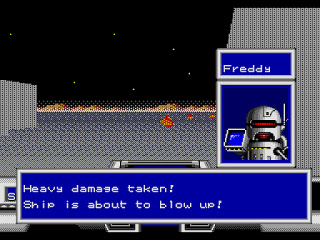
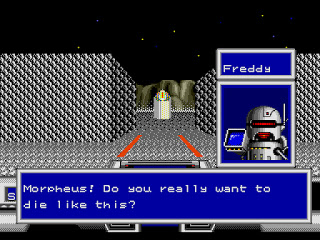
I can't even see him, I think this might be worse than even the endgame fights!
The game starts with a simulation of combat, but you don't know that. It seems like a difficult battle straight up after starting, a common, but very annoying trope in Japanese games. Perhaps there is a way for someone just starting out to win it, but I doubt it. When you get defeated, you end up talking to a sentient robot, Freddy, and your near and best friend Gibson. While the game's brief approach to dialog usually doesn't help the game any, I get the feeling that if it weren't, Freddy would seem like one of those very annoying sidekicks, and Gibson would be one of those annoying Sasuke types. (whiny backstabbing rivals, for those of you not up on your anime) Freddy acts as your eyes, ears and most of the time voice to the outside world. The story has a very Japanese approach to it, what you want to do is entirely irrelevant. Even so, it feels a bit weird.
The basic gist, that I could get without the manual, is that the human race has expanded to about three star systems, Sol, Sirius and I think Alpha Centauri. To protect their holdings, Federal Patrol was founded. Federal Patrol oftentimes employs "hunters", to do things they need doing. The player is a hunter, along with Gibson. I'm probably wrong, but filling in the gaps I'm probably supposed to be a bounty hunter. With all the nasty bits that includes. There's a weird feeling in this game that makes me feel that's true. Recently, an anti-alien organization called VOID, lead by Geist Nidoman has been stepping up their activity, building a Great Battleship and the titular Star Cruisers.
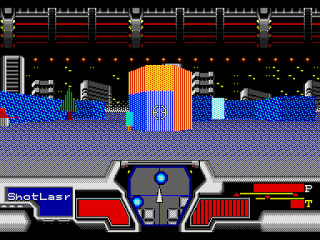
Hope you like the way this looks, because you're going to be staring at it for the next 10+ hours
Controlling the game is annoying and feels like the game isn't responding half the time. You have your standard Wolf 3D style movement with the d-pad, while C shoots. A modifies your movement, sidestepping on the ground, speed controls in space. B cycles through weapons. One of the big problems with the game is that it constantly slows itself down and doesn't seem to work too well when that happens. This seems to happen over the silliest of causes. In combat, it seems like even firing your gun can cause these bizarre slowdowns, which in turn leads to shots not firing. I don't think its a heat mechanic, at least probably. Moving around can cause these delays too. No matter which way you take it, unintentional or intentional, it doesn't mesh well with the game and makes it feel broken.
This also leads to a problem later on where one of the weapons seems a lot worse than it really is because I didn't realize until long after I got it you were supposed to hold down the fire button with it.
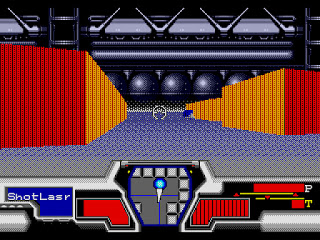
A dungeon, not quite sure if you can tell the broken visual nature of the game from this
As soon as you exit the first dialog and enter the game without threat of death, the flaws in the 3D become very apparent. Its got Wolfenstein-style walls, 3D objects in the world, and a pixel art skybox. This might just be me, but I found the experience to be very headache inducing. What isn't me, is how unusual this looks in action. What you can see, what is actually there and whether or not your enemy is going to hit you all seem to be three different things. So you can see past walls in a way that doesn't look normal, and its kind of freaky, even hours in.
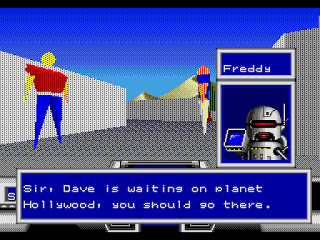
Remember, every wall is as tall as a building

Another issue is that the size of things is weird. There are one story buildings and two story buildings, and presumably these aren't properly scaled. Fine. Vehicles range from being shorter than you to much taller. Also fine. All starships look like they're fighters, but since they can enter space, I guess that means they're X-Wings or something. Fine. Humans are the same size as a ship. Weird. The player's spaceship is actually some vast ship with a pretty big, but unshown interior. Huh? But its also the same size as a land tank you can drive around in. I feel like my eyes are lying to me or something. Its annoying as hell.
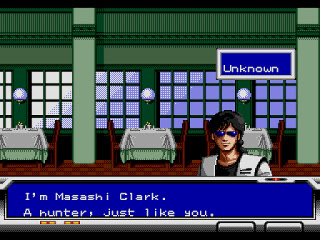
"...and I'm just so much cooler than you."
You don't start the game with the Star Cruiser, a superpowered and modular spaceship that is more powerful than any other ship in the galaxy. Instead you steal one located on a bigger spaceship just outside the starting location of Ganymede. Taking the ship, and then upgrading it takes up most of the early hours of the game. This introduces most of the major cast, The generic waiter in every restaurant in the galaxy, Masashi, a cool hunter, Daigo, genius scientist, Yoko, his archaeologist daughter, Max, Yoko's student, Diane, Max's sister and Federal Patrol intelligence agent, and finally General Tomovsky Hermann, one of the heads of Federal Patrol.
This game doesn't really expand on its characters too much owing to the limited amount of space it had for dialog and text. Again, this is not a bad thing, because I get the feeling if it expanded on it, it'd be anime, the bad kind of anime where characters expand on their motivation for far, far too long. However, a lot of characters feel one dimensional, so its not all good. I am curious about the quality of the translation, if its bad or good. It could go either way. I've picked up on things that might be errors, but at other times the game forgets to include instructions on your next destination, which screams that the game was made that way.
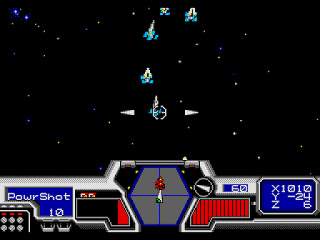
One of the most exciting encounters of the game
The space combat is the best element of the game, and that's not necessarily a bad thing. Its biggest problem is that there's a maximum range before enemies disappear, and its far too short. The game is kind enough to remember how hurt enemy starships are though. Bit of the standard, "figure out where the enemies went" type of stuff, but once you figure out the radar you shouldn't have too many problems. They're a bit spongey, with some multi-ship battles taking much longer than they need to. Space combat is only rarely needed, you only have to fight them about 5 times, and out of those times there is no real benefit to fighting them. Non-essential combat is completely pointless, since there are no, or at least close to no dropped items and most of the time you can fight these unnecessary battles, you can run back to a repair station on any friendly planet.
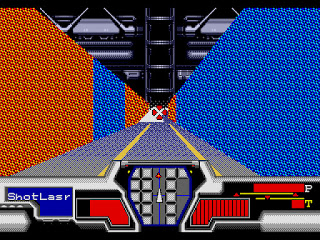
Action! Excitement! Something of interest!

Ground combat in contrast, is far more necessary and far more boring. Enemies run around taking potshots at you, while you try to shoot those shots down and hit them with some of your own. Not all fights are essential, but its rare that you'll figure it out until after the fact. It doesn't feel like there's any cleverness going on, just the simplest of simple combats. Hammer the attack button, later hold down for the rapid-fire weapon, finally wait to charge up your weapon. Or use missiles, but you have a limited number of those. I will say that all the weapons in the game were useful at some point, even though I didn't quite grasp it at the beginning.
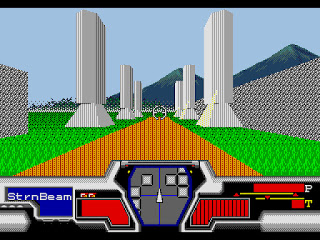
There are flashes of something that could be described as scenic beauty

Which brings us to the level design. Despite being...crap, the level design shows quite clearly the mark of the kind of design later FPSes would get up to. Teleporters, keys-and-doors, switches-and-doors. Every hallmark of classic FPS design that doesn't involve a Z-plane. Don't mistake that for good, this is firmly in the boring maze department. This is basically what people imagine old FPSes are like. You'd think with the strong RPG-influence on the game, someone would have taken a page out of that book and do something interesting, but it never does.
Sometimes the games goes as far as to show a teleport and a locked door and no other path. The teleporter leads to a key. Why did we need this? It feels like something someone would do if they were just starting out in designing a Doom level and wanted to test that keys and teleporters worked. Later in the same level, there's a one way arrow floor, and a teleporter. That teleporter leads behind the one-way arrows. They're just copying elements from other games without understanding why they worked. I find this all slightly curious, since Wibarm was decent for the brief period of time I played it.
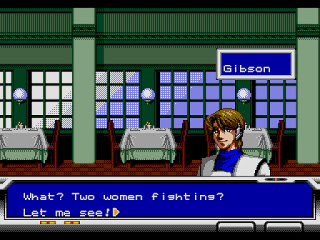
My in-game best friend, a mature and reasonable human who would never result to anything vulgar at all
As to the sound, I spent considerable amounts of time with it off, unusual for me, but the music isn't that good to justify listening to for the game's length. No real statements other than generic JRPG music. You're liable to listen to five of the tracks thousands of times. Sound's okay, but thankfully non-essential. I listened to a lot of actual music, simply to keep myself sane during some of this. Because this game is too long.

Speaking of RPG, this game gets the label RPG quite a bit. Its kind of weird, because its in that category of not really being one despite the influence the genre had on the game. While you do upgrade your ship over the course of the game, its linear upgrading tied into sections of the story, closer to an action game's upgrade system than even a JRPG one. The level design is obvious, but so many games now have that kind of influence it doesn't seem like much of a sign. The way you interact with the world and the way the plot moves forward are very JRPG-ish, but I'm not sure I'd describe that as a core aspect. I did some thinking, readjusted one title I wrongly claimed was a RPG, and decided to take the Addict's way of thinking and say it wasn't because it all happens at predetermined points.
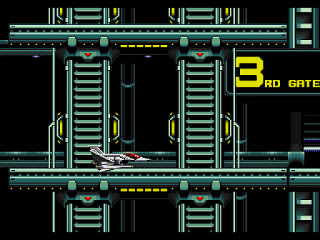
To another star system!
After traveling through Sol for a while, the game begins to tell you about a Gravity Catapult, which though the game does a poor job of explaining, is the method of intergalactic travel in this universe...well, for the most part. Up until this point I assumed the game was set entirely in Sol, but there are four star systems, three of which we can reach through normal travel, with one acting as a sort of final dungeon. Innersystem travel is done with a warp function, or just by flying somewhere. The warp function uses a lot of energy and doesn't have a great range, so there were times I just used it as a short-range map. I've lost track of most of what happened here, because the game looses focus and goes through all three systems throughout much of the remaining section of the game.
While for the most part, suffice to say there are quite a few twists and turns, and quite a few traitors in Federal Patrol, some elements of the game are a lot more mature than I was expecting. At some point you have to infiltrate a captured building, and one of your allies gives you some gas with which to knock them out. After doing the usual boring playthrough of the level, I can put the gas into the air vents...at which point it turns out the gas is lethal. While the game describes it as awful, its ultimately just accepted and there are no consequences for this event. As strange as it sounds for a source of praise, I was expecting some stock anime plot where we discover we were working with the bad guys all along and the people we were fighting were the good guys, but I guess one of the Final Fantasy titles created this line of cliche and Star Cruiser was lucky in when it was made.
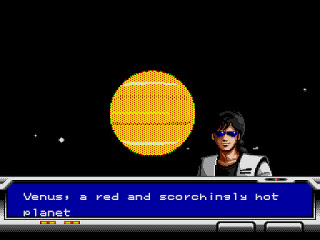
In-universe its been terraformed into a green planet with the use of a giant heat shield

Let me just mention some of the planets in this game:

  • Pluto 2
  • Hollywood (before anyone had thought of that restaurant)
  • Old New York
  • Folder
  • Egg
I can't remember what this was about, but I'm sure it was quite dangerous

This game just doesn't end, despite feeling like it should have ended much earlier. At first this was due to annoyance with the game, after a while I got used to the awful elements of it. But then we take out important antagonists left and right, and when they're all dead the game is still going, because we have unfinished business. That's not the worst aspect, because its in this section where I have to get one of my associate's associates to seduce the twin brother of some slimeball merchant to find a base. This is hour 9. There was still more interesting stuff and more boring stuff to be beheld.
We even still have plot twists, and major known members of VOID are still alive. I'm desperately hoping the game will end, and its still throwing out new elements. In-game we hear a voice helping us when it seems like death is inevitable. A helpful voice. I feel like if I had one of those it would be telling me to quit because this game is throwing another maze at me.

Darth Yoda and his planet full of clones, or perhaps the developers are just prejudiced against aliens

Then it gets interesting again. I arrive on a planet full of aliens, though they are a bit...obviously inspired, to put it politely. The aliens believe that VOID are the good guys and that Federal Patrol are the baddies, and thus its another "clearing my name" section of the story. Things do get a little repetitive story-wise, but I must admit this version of it feels a bit cleverer.
Eventually, we engage with VOID's leader, fight him, and destroy the Great Battleship of theirs. We find out one of the stupidest plot twists in gaming, where we discover who the voice is. I'm not going to tell you, you don't deserve to be disappointed like I was. Peace and order is restored to the galaxy and everyone gets their happy ending. The end.
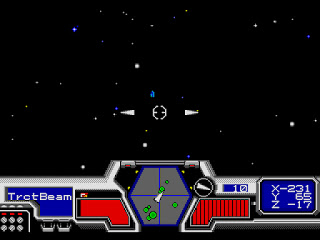
More of this, less stuff on the ground
Compared to early western attempts at the genre, I feel like this game would have been improved greatly if it had the western open-ended approach. You have a bunch of antagonists that move along their own lines, and you, possibly your team, deal with them across three star systems. Done in a way so that the primary purpose of the game doesn't just revolve around taking out one major target, like in Mike Singleton's games. The linear nature of the game combined with the laughably bad dungeons hurts the game more than any other aspect of it.
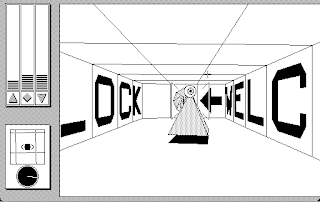
This is the closest western attempt, The Colony, and I hated playing it

But despite all this, here's the thing, this game was released in 1988 originally, before anything we think of as being the first FPS, and before the space sims that proved the most enduring, like Wing Commander and Tie Fighter. The only practical comparison in the latter is Elite, which suffers from the problem of being too open. It may be flawed in aspects we find important now, but its like complaining that a film from the 1920s has awkward camera work and no real sound. Everything it built off of has slipped away in memory, like cherry blossoms in the wind.
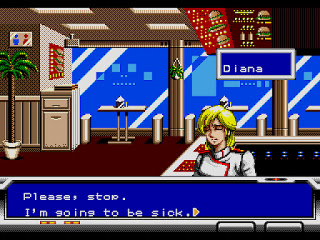
A lot of these screenshots are pretty amusing outside of context though
Weapons:
Nearly every weapon was useful in some form or another, not throughout the game, but whenever I felt shafted by a weapon it turned out there was something I was missing. 4/10

Enemies:
The only real differences between enemies is how many shots they take and visual ones, most of which doesn't feel different. 1/10

Non-Enemies:
I think there are some at a few points, but I'm not really sure how much they contributed. 1/10

Levels:
Despite coming from what is supposedly a RPG-style every tile counts with some common blobber trickery, there is absolutely nothing going on in any of the dungeons worth talking about. Even Wibarm felt like it had better level design. 1/10

Player Agency:
I never felt like I was in proper control during the ground sections, though the space combat sections are decent. I liked in those sections that the game carried ship momentum. 4/10

Interactivity:
Very limited interactions. Nothing more than a few token puzzles and false walls. 1/10

Atmosphere:
The game does a very good job at making the player feel like he's in a low rent space opera, travelling from alien world to alien world. Teeters the line between being anime and not, but then again I am biased. 5/10

Graphics:
While the 3D looks awful no matter how you slice it, the 2D feels kind of mediocre. There's just nothing about it that makes me go, oh, I'd like to draw like that. 3/10

Story:
The limited amount of text the game has to work with works both in favor and against the story. We don't get much motivation on some characters, and as a result their actions seem like random acts of idiocy. Other times the game is surprisingly intelligent and doesn't treat the conflict as entirely black and white. My biggest issue is the player's practical non-existence. 4/10

Sound/Music:
I'm not really sure I like the music, even discounting it being about 30 minutes long in a 14 hour+ long game. A lot of sound effects lack punch, and despite having turned off the sound for long periods of time, I don't feel like I missed anything. 2/10

That's 26, in recent memory only really comparable to Day of the Viper.

I don't know how to feel about this game. Its clear that the game lasted a lot longer than it needed to, but its also a very important game, certainly so for the Japanese. Its all so funny finding these games that beat the boys at iD to their presumed punch yet nobody knew of their existence.

Now, despite being a port of a PC release, this had several changes in the process, meaning at some point I should play that. I can't imagine that not being superior anyway. It was also translated. However, because of those possible translation issues I noticed, I'm going to wait to play that until I can read Japanese. The same is true of its sequel, Star Cruiser 2, translated into English, but I'm going to wait. I also think I should start watching some more Japanese media, since it feels like its going to be important to see what these games are knocking off as surely as western games knock off Alien and Arnie movies.

As an aside, I've noticed during these past couple of Wolf-clones that I've been developing headaches as I play them, and its not necessarily because they're bad. I checked my memory, and it seems to be a consistent issue. But that said, I'm not sure if that's because of the visuals or the audio. I noticed I didn't have any when I turned off the sound. Come to think of it, I can remember the issue happening with some console titles that don't have anything to do with shooters.