Name:Ultima Underworld
Number:107
Year:1992
Publisher:Origin
Developer:Blue Sky Software (Looking Glass Studios)
Genre:RPG
Difficulty:2/5
Time:14 hours 45 minutes
What can I say about Ultima Underworld that hasn't already been said? One of the greatest RPGs of all time. A technological marvel and important milestone in gaming history?
Meh.
The reception of the game, which is practically unavoidable, is that the game is flawless save for technical issues owing to the age of the game. A small price to pay for the first...3D Ultima. There's a lot of you had to be there said of the game, which I guess is true, but speaks of a game that has aged more heavily than people frequently give it credit for. And after playing it, I'm not sure that the game would have been flawless even back in the day. First, let's talk about how it aged.

The control scheme of the game has more in common with the games that came out beforehand, even games released one year later are much smoother. We've a quasi-standard control scheme, SZXC moves, W moves forward faster, A & D turn. Its mostly okay, but moving backwards always feels weird. Oddly slow. It works, barely, but its enough to be very noticeable. One nice feature here is that you can only walk off a ledge if you walk forward. Something that does work for both you and the enemies in-game. The real issue is looking up and down, which uses 1 & 3, with 2 to center. Its such an awful selection of keys to use in this case.
Underworld uses a somewhat adventure-style interface, meaning that you have the standard adventure actions of look, use, talk and take, along with options and attack. Which is interesting in theory, but awful in practice. The function keys select these actions, which is the ideal way to use them, but they had a habit of activating twice with each keystroke for me. The menus also worked awkwardly in of themselves, I nearly saved over an old save when I meant to load multiple times.
Also, the whole package is very awkward to use compared to games that came out afterwards. The adventure-style interface is more of a hindrance than a help. Picking up items is a troublesome experience. To say nothing of just how interacting with the environment is a bit tricky. NPCs, like in most RPGs, are fond of walking away when you're trying to talk to them. However, here is a feature I've never seen since, you can just walk into them to get them out of your way. More RPGs needed to take this feature of all things.
 |
One of the first of many platforming sections
|
We are also regaled with jumping, which uses the J key, and depends on a skill. Jumping is awful. Really, really awful. Part of this is down to the collision physics, which will shoot you back if you hit a wall, and believe me, you have a very unusual collision box that guarantees this. The other part is that the developers designed the platforming parts in the most annoying way possible with this in mind. You will absolutely fall victim to the collision. Its just a question of whether or not you're going to hit the ceiling or the walls.
 |
The slaying of vermin, a common sight in Ultima Underworld
|
Combat is easier, but suffers from numerous flaws. Underworld has three attacks depending on the mouse location or button you press and you hold down the attack button and then release. At first fun, but it doesn't have much tactical depth, most enemies should be dealt with one particular attack. All attacks have to be held down for at least a second, there's no jabbing. Despite being a RPG, spells and missile weapons are only useful as a self-imposed challenge rather than an actual tactic choice. Further, becoming skilled in a weapon other than a sword is intentionally crippling yourself, but that is more a timeless issue.
 |
Its really hard to get the distortion across in a screenshot, unfortunately
|
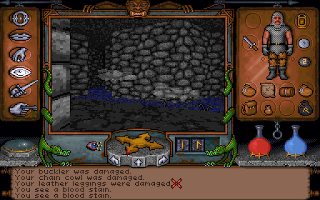
A big issue in this game is the 3d engine itself, which has a constant visual issue at the sides of your view. Walls look weird as you walk past them. Eventually one will get used to it, but its very noticeable and very distracting at first. While you should be using the look action at most walls anyway, most secret doors are supposed to be visible without that, meaning anything other than a thorough search is in danger of missing something important. There are also numerous other visual glitches.
 |
One of many friendly NPCs with a quest for me to solve
|
However, the worst issue of all is a two-edged one. There are too many quests for a game without a journal. Let us talk about me personally, someone who is generally willing to give a good game a chance. I have in the past made maps for multiple games. I have in the past made notes for the puzzles in a game. I have not, and I do not think I ever will, made a journal for a game. This is ultimately too much effort for what is supposed to be fun; I don't make notes for novels unless I have an important reason, I mostly just make notes for actual information books. This game requires those notes, because by the end of it I had no clue how to find one important plot item despite nearly being done. Its too much like actual work.
Those are all the features that aged poorly, however, I do not think the flaws of this game lie exclusively in the game's age showing. There are some aspects of the game that were always bad.
 |
The first shrine I found...on the second level
|
For a RPG, the RPG aspect of the game is incredibly weak. While level advancements happen normally, in order to raise a skill you need to find a shrine and find the mantra for the skill. Which is just busywork. I'm not opposed to the idea of a specific location or person being used to train up your skills, its just that Underworld's approach is unnecessarily complicated. The system for this is vague, but that's the least of its problems.
Some of the skills themselves are of questionable use, to some being outright useless. I briefly touched upon it with weapon skills, but there are a lot of utility skills without much point in using. Swimming is a skill, but all the skill governs is how long you can swim without losing health. There's lockpicking and something to do with traps, but every door has another way of opening, even if brute-forcing it, and I don't remember any traps a skill would help with. Bartering skills, but bartering I'll get to in a moment.
Further, there's a level-gating approach in-place. That is, if you aren't at a certain level, enemies are basically invulnerable. Its only in place to prevent players from just steamrolling over everything right away, because most enemies, once you get to that level, aren't much of a problem. I have never seen this used well in a game and here its no different.
While the game supposedly offers a wide variety of classes, because some skills are useless and the game heavily biases you towards melee combat with a sword, there's a clear tier system. Being a primarily spellcasting class cripples you in three ways, there is a minimum range, and while you are faster than enemies, you don't always get enough range to use spells; Mana is limited, and while it does regenerate, that takes time; Finally, there is a level where you are drained of all mana. Ranged weapons are ineffective and utility skills don't help with combat, and there is a ton of combat. And these lead to the magic system feeling heavily underused.
 |
A shot from the intro, where the player is forced into finding the baron's daughter, something that doesn't really affect the game until 7 floors down
|
In story, there's not really any reason for me to believe him, at least until his dead brother, who has appeared in visions at the start of the game, tells me the whole thing is real. At which point I am to take the eight items of virtue inside the Abyss and cast them into the lava pit the demon is on-top of. Unfortunately, the game failed to spawn one of them, resulting in all life on the planet dying. When I say I'm supposed to take those, I'm also supposed to figure out I'm supposed to use those and the lava in order to win. I also had no reason to find all eight items of virtue until this point. The main story of this game seems embarassing for such a highly acclaimed RPG.
Further, this whole thing leads to a massive pacing issue in the last part of the game where you're finishing up whatever sidequests you left hanging in the hopes it reveals where some important item is, in addition to the final level just being a general slog.
 |
This is the first goblin you see, you cannot be friends with him
|
 |
This is one inside the settlements, as hinted by banners, he is always friendly unless you stab him, like most NPCs in RPGs
|
Something that sort of is a complaint more about what people say about the game, but there's a certain infamous magazine review where someone dissing Doom in favor of this complains that you can't become friends with the monsters. I want to point out it isn't true here either. While some of the friendly NPCs are indeed more standard monster races, you can't just talk to a random goblin and become his friend. There's no diplomacy or anything, enemies are always enemies. Its basically your standard RPG except some NPCs are ogres.
 |
I used this system so seldom that I used a screenshot from repairing a plot item instead of actual bartering!
|
There is a bartering system, but there's no real reason to get very good at this system. With skills or actually thinking about things. There are enough spare items hanging around that any item you really need from someone is easy enough to trade for. One of the early characters makes a big deal about items and survival, but that's simply not true. Further, you have a limited carrying capacity governed by your starting strength stat and carrying around all those trade goods, or even gold, takes up quite a bit of it. So quickly the ideal way to barter is to ignore all the gold and just carry about some gems in case such a thing is necessary...except that people actually want gold in exchange for some services. Some of which are absolutely vital to solving the game.
Now, with all that said, one might ask what is good about this game? Or if you are one who greatly enjoys this game like many do, a moment to cool your jets before going into a rage of some kind.
Origin, the publisher and at the time of development the company that Blue Sky was effectively a division of, used to have the label "We create worlds". It was only the motto of Origin, but a strong undercurrent of this went on throughout the '90s. While it is annoying that they spent so much time on the backstory and not the main story, it does create a pretty nice atmosphere to the game. There's a distinct feeling when the game begins that you are being thrust into a strange world. That you are just one player among many with their own goals and objectives. It doesn't quite live up to that opening feeling, of course, but it keeps the illusion going for longer than most games.
For instance, on the 3rd floor there is a NPC who is mad and deeply afraid of the dark. So he is someone who trades for light sources and food. Being that at this point you probably have plenty of food and a magic spell that creates light, well, he isn't really worth trading too. One floor down another NPC mentions that the crazy NPC went into their camp and stole everything he could, including a candle that never stops working and is one of the plot items you're looking for. There's the distinct feeling that most NPCs are actually important to the game itself since so many turn out to be vital later.
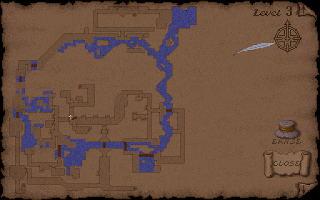 |
A screenshot I took of the map fairly early on
|
The dungeon design itself is wonderful for the first 6 levels. While the motivation for exploring is a hollow one, I don't feel cheated here. Exploration feels rewarding here, you even get XP for it. There are enough nooks and crannies filled with treasure or plot coupons that it all feels worth it. Even scouring the walls for secret doors. I can't say that much about most actual FPS games.
And while I do criticize those last two levels, its because of decisions that affect part of the level. Level 7 has three mazes in it and a good chunk of the level just moves awkwardly; Level 8 comes after killing the villain you came to the dungeon to defeat, when you're at the final character level. It shoves you against an absolute swarm of enemies, which at this point just feels like busywork. If the game situated the game's main villain here as opposed to the level above it, this section would be more tolerable.
 |
This is possibly the first enemy in the game, and you have to attack him first
|
While the controls have aged poorly, even in comparison to other games of its control scheme, there's no denying they set it up in such a way that even a rank amateur should be able to get used to them. Even discounting that the manual contains a tutorial designed to introduce people who didn't even use mouses to the game, the game is just designed in such a way that allows players to easily get used to the game. Not just an area free of monsters, but an area with all sorts of items the player has to pick up to get used to the game, and interact with in all ways the game is going to use over the course of the game. I feel like a big flaw all of the games that use this control scheme in 3D afterward do is have enemies start near enough the player that he has no chance of getting used to the game before dying. Something that is incredibly frustrating.
To add to this, the game is also easy compared to those titles. This is not necessarily a bad thing in this case, because the game isn't really built for something hard. This makes it a perfect title for those getting into pre-mouse look RPGs and some FPSes. Assuming, of course, one is even capable of playing a game without mouselook without turning into a blubbering wreck. Hey, I still have trouble keeping planes up in the sky.
 |
Fishing in a dungeon
|
There are a lot of little things the game does really well in a way that hasn't been replicated much. Being able to push NPCs out of the way as I mentioned. The in-game map, while an inventory item, is one of the smoother ones I've seen, and works incredibly well for 1992. There's a fishing mechanic, where you can get fish via a fishing rod you find on the 4th floor. Unlike many other games, where this would result in a poorly thought out fishing mini-game, this just gives you the fish or it doesn't.
Ultimately, Ultima Underworld is unique. (except for its sequel) For all my comparisons to various games over the course of my playthrough, it isn't any of those. They're only like this game in one aspect or via obvious technological heritage. None of them ever fully got the appeal of the original game. I don't think its ever possible to get that appeal ever again. Even today nobody's gotten a real successor to it, despite many chances to do so. I think that of itself makes it worth playing.
Weapons:
Like usual with RPGs, the different weapons weren't very different from each other, although there was a noticeable power difference between end-game weapons and skills and starting weapons and skills. Ranged weapons and magic are more or less in utility roles and are not effective for actual combat. 1/10
Enemies:
A limited variety of your standard fantasy enemies. Very few are unusual or require special tactics. A big problem here is the readability of characters, you have to use the look command to see if an NPC is hostile or just wait until they decide to attack you. 3/10
Non-Enemies:
While a great source of information, they don't contribute anything to combat, and indeed get in one's way. At least the developers realized this and allowed you to move them out of the way by running into them. 2/10
Levels:
The first 6 are incredible, a true masterpiece of level design. Then we get level 7, which is constant mazes, and then level 8, which just feels tacked on. 8/10
Player Agency:
While I am more open to the combo of the keyboard doing all the movement and the cursor doing every action, this tested even me. There was a distinct habit of the game to have button presses and mouse clicks happen twice, often enough that I suspect it was the game's fault rather than my keyboard and mouse. The adventure-style interface also hindered rather than helped the gameplay. 4/10
Interactivity:
Despite the adventure game interface there isn't a lot to do. A small selection of scenery items are actually interactable, though anything can be destroyed with a fireball. Otherwise, items work like they usually do in RPGs, though you can throw items in lava and water to destroy them, something useful if you're playing the original version, but nothing terribly exciting. There are puzzles, but the only difficulty is in determining that you are actually in front of a puzzle, since most are straight-forward or something you need to find a solution for elsewhere. 3/10
Atmosphere:
The game does a good job of making you feel like you're trapped in a desolate dungeon, moreso than it actually succeeds in making you trapped in a desolate dungeon. The short draw distance, the somber music and the way all the NPCs speak of the past in nostalgic ways all contribute to this. I particularly liked one NPC, longing over her lost love, stares wistfully out at a river of lava, because that is the best she can do. 9/10
Graphics:
I know I've said its hard to do dungeon graphics in a way that doesn't look boring, but something doesn't sit right with me about this game. Its not just that the engine basically forces a fisheye lens on you, the whole thing looks lifeless. Character sprites look flat and just about everything feels like it was someone's first attempt at making VGA graphics. 3/10
Story:
For a game that has such a rich and complicated backstory, very little effort was put into the actual story. 3/10
Sound/Music:
Everything is done via sound card, including sounds. While I used a Roland MT-32, which had the better music, sounds were...not great, since they were just musical notes. That said, despite being very obviously limited, music was very nice. The much vaunted dynamic music simply amounted to the music changing depending on if I was walking around, had a weapon out or was in combat. 5/10
That's 41, but minus one point for having so many game-breaking bugs, so 40.
The obvious comparisons are to Dungeon Master and Shadowcaster. And I would say, of the three, Ultima Underworld is my personal least favorite. On a regular 5/5 scale I would give Dungeon Master a 5, even if it would be lacking on any genre-encompassing scale. It is just absolutely amazing as a dungeon crawler. Shadowcaster is a game I grew up with, but in several ways it works better. It controls better, combat is more interesting, and while it has worse level design, the atmosphere is still top-notch.
I do recommend Ultima Underworld, however, be aware of its flaws. Many people say this is one of the greatest games of all time. I don't think it quite lives up to that. It occupies an awkward middle ground between better action RPGs and better "role-playing" RPGs. As of now it is in the top 10 of all the games I've played on this blog, but that's something that will very easily change, since I'm still firmly stuck in the 88-93 period.
This is one game that could stand a remake. Unlike with other games that had significant issues but mostly solid gameplay, the part of this that is great is the dungeon itself. A transplant into a completely different engine with some changes to gameplay, akin to the early attempts with Blood or some attempts with various Elder Scrolls titles, would do wonders for the game.