Tuesday, May 17, 2022

The Colony

Name:The Colony
Number:125
Year:1988
Publisher:Mindscape
Developer:David Alan Smith
Genre:FPS/Adventure
Difficulty:4/5
Time:1 hour 15 minutes

Today's title is a bit unusual. I say unusual, as if any title that qualifies as a FPS from the '80s has been normal, even the closest we've gotten was Midi Maze and even that was a bit out there. No, today we have The Colony, a FPS that plays more like an adventure game, and yet the adventure game aspect seems totally tacked on. Originally released for B&W Macintoshes, before getting ports to Amiga and DOS, the former being the one I'll be playing for reasons I'll explain shortly. The Colony is very technically impressive, something I'm sure could be ported to everything under the sun. This is also the first game I've seen where someone involved with the original game, in this case a producer, claims the title to be THE first FPS. As you can already guess if you've read my blog for a while, this takes the Freescape engine approach to things.

The story is, the player is sent to find out what caused a colony to lose contact with the rest of the galaxy. In approaching, he smashes into a black hole, escapes and crash lands on the planet containing "the colony". The latter half is in the intro. I had a curious experience with this game. First I played the Macintosh version, the original because B&W Macintosh titles are cool-looking, then the Amiga because the original was seemingly unplayable, and then the B&W Mac version again because I figured out what I did wrong.

The bridge, after turning on the light

After the nice animated intro, the game starts...and its awful. I hesitate to start a review like this, but, holy crap, this is bad. The intention of the game is that the player goes to the nearby control console and turns on the lights. Which works somewhat in the Amiga version, not in the Macintosh version, which is pure B&W. So all the walls are just black and the doors are just there. The problem connecting this is that the nearby console, an obvious destination, has two buttons. One turns on the lights and the other causes the ship to explode. When you start up the game you might press them both, think that you shouldn't do that, and then screw around in vain for the next twenty minutes.

The control panel, having the two big buttons be light and cannons seems a bit overdramatic to me, but what do I know?
But enough about that, let's talk about the controls, and boy, howdy, this makes the Freescape games look like a modern console shooter. In theory you have the standard FPS controls, WASD + mouse, which this is actually the first game to do to my knowledge. Except these work quite poorly. Very, very poorly. The mouse is your standard awkward mouselook and moving that was standard before people figured out the standard usage. Its awkward, but it works. The keyboard controls are stiff, and make me yearn for another Freescape game. Something I shouldn't have to do, owing to the massive number of those.
Right, four paragraphs and I haven't actually played the game yet.

A typical scene
Once in motion, the game is weird. I don't think its weird in a bad way. You know all the amateurish backgrounds you see in amateur adventure games. Well, its like that, except in 3D. This actually looks pretty cool in-motion. Interacting with items in the environment is done by moving into them. This looks akin to a more standard first-person adventure game with some simple animation. I should note that walking into things seems to slightly damage the player otherwise, which is just a bad design choice. Once interacting with the environment, which include computers that look suspiciously like classic Macs, things turn into a standard adventure game screen. Except that random things can and will kill you, not only the aforementioned self-destruct button, but a cigarette.

Choosing ones weapons and armor, the heavier they are, the more energy they drain, and you can run out just walking around


Now, I should point out that you don't even get to shoot anything until you can figure out how to put on the suit of power armor. By the time I actually got to something I could shoot it felt like an accomplishment. Sort of, because when I got out of the ship finally...it was like Battlezone. Except on a Mac, controlled by the mouse and slow. The actual objective at this point is to find the entrance to the colony, but all these...uh...aliens, even though they look like robots, are in the way. Kill them or not, its all pointless, because this screen is just here to drain your life.

In case you didn't believe me
Once I make it into the colony, I'm greeted by...an enemy. At first I think combat is like Freaks, but I'm just playing poorly. It is the first use of "kill enemies and walk over their corpses to heal" that Freaks did. What is actually happening, as I discover in a slide in a meeting room* is that the aliens are energy beings, whenever they got shot enough, they suffer an energy overload and turn into eggs, which are pure energy and thus heal/restore ammo. Incidentally, this was caused by a teleporter disaster. I didn't realize that wasn't something Doom originated. There's even someone who calls them demons! And it appears the aliens don't use eyes to see things, because they saved the children by cryogenically freezing them.
*Yes, apparently while the the base is slowly getting ripped apart by aliens, staff found the time to prepare and have a meeting. Can you guess what nationality the creator of this game is?
Am I fighting aliens, robots or the Illuminati?

Thus this is the game loop for the rest of the game. Try to kill the weird-looking aliens in a panic, hope not to use too much firepower, and learn more about what's going on. Basically the first FPS to try the whole "reconstruct the events that caused so-and-so great calamity". Its just a shame that this game plays so badly. Like, holy crap, this controls like ass. The combination of slow speed and awkward controls makes the whole experience very unfun to control. Every shot causes a brief stop, and its intended for it to run slowly.

The purpose of the mini-map in the lower right is basically just to tell where you are in relation to nearby environmental objects
 Once some time is spent reconstructing those events, the objectives become clear. The colony needs to be destroyed, lest the aliens escape and wreck havoc on other worlds. The messages from the dead imply that I should cause the reactor to self-destruct. The game implies otherwise, as saving the children implies I can also save myself. From messing around on my ship, I know I can take the reactor core out of mine, and since its destroyed because of the crash, I can replace it with the one from here. Clearly the "self-destruct" button is just broken on the planet, and is no doubt some weapon. Unfortunately, the game doesn't allow you to carry multiple things at once, and I doubt my abilities are enough for as many trips as the game wants me to take. Plus, I don't know how to take the cyro-pods, so I guess they're screwed anyway.

More fighting, this doesn't look any more exciting in motion


On each level is a queen, and killing that queen causes most enemies on a level to die. And when I killed the queen on the second level and all that was left was an abandoned colony...I felt little desire to continue playing. Maybe its because I know I can't really win the game at this point, maybe its how slow it is, or maybe its the sensitivity of environmental objects, but I just felt like I had seen all that there was to see.

Eggs, any one of which could turn into an alien at any moment
Weapons:
Generic laser weapon. 1/10

Enemies:
The game tries to have the different aliens do different things, but in practical terms you've got three or 4 different kinds of enemies. 2/10

Non-Enemies:
Effectively items. 0/10

Levels:
The Colony is clearly going for a more realistic style in an era where that's just not possible with 3D technology. The series of corridors connecting various logical rooms just felt like work navigating through, to say nothing of the outside area. 0/10

Player Agency:
Technically it works, but I've never seen a more awkward implimentation of a control scheme. The game requires considerable precision in aiming and moving, especially over the alien eggs. However, the keyboard controls feel straight out of a Dungeon Master-clone, while the mouse controls, while better, are still awkward. 0/10

Interactivity:
You don't get any environmental interaction unless you walk into something, and this is overly sensitive. Sometimes you get adventure-style scenes, but these all fall into a simple pattern quickly enough. 3/10

Atmosphere:
The game does a good job of feeling like a lone space marshall uncovering a mystery on a faraway world. However, it doesn't do a good job of keeping it. 1/10

Graphics:
Well...it looks okay. Its not bad, its not impressive, everything is just sort of there. 1/10

Story:
Its cliche, but its well-executed. The real highlight of the game for me was the information the game was slowly telling me about this alien menace. Its just not enough to actually save the game. 3/10

Sound/Music:
Actual sound effects, and a brief intro tune. Unfortunately, it seems like any time the sound effects go on the game stops and they're very low-quality sound effects. What was once decent sounding quickly turned into noise. 1/10

That's 12. Good concept, bad execution.

Curiously, reading period reviews, it seems this opinion isn't unique. Almost as many say positive things as they do negative things. Quite a few implications that this game only got as popular as it was because it was the only option for the game poor Macintosh. This would explain the constant, false claims that this is the first in most categories that its said to be. Neither the producer nor the author actually played any games. This also goes well with the author's future work just creating 3D worlds, which was used in The Abyss, possibly others.

Unlike in a lot of cases, we have the author's own words on the matter. Its a very interesting look back, going on to explain why Macintosh games were not great, the issues he had with publishing it, and the technical choices he made during development, and brings up when we'll see this guy again, with the last of the Tom Clancy submarine games.

That, in theory, should be the last proper FPS of 1988. Next up 1989, a year I'm looking forward to.

Saturday, May 14, 2022

Wibarm

Name:Wibarm
Number:124
Year:1986
Publisher:Arsys Software
Developer:Arsys Software
Genre:Side-Scroller/TPS
Difficulty:4/5
Time:50 minutes

Wibarm is the debut game of famed Japanese company Arsys, who would go on to develop the famed Star Cruiser series. The company was formed by disgruntled Tecno Soft employees, and as I understand it this is an advancement of the tech developed in some of those games. However, today we're only interested in the direct ancestor of Star Cruiser, which is this, a side-scrolling platformer/TPS with RPG elements. What's interesting about this game is that there's a DOS version ported by Broderbund, which I didn't start off with, instead trying out the FM-7 version.
The base screen, get used to seeing this a lot

The intro, which was in English originally and then rewritten to be clearer for the Broderbund release, tells us that in the aftermath of a nuclear war, the "big countries" continue to produce weapons. A rebellion breaks out, which I think causes monsters to be released, who then break the communication link between a power plant tower and the power plant orbiting around the Earth. The power plant's orbit is decaying and will soon smash into the Earth and destroy it. Music accompanies this. After that, the game goes straight into a weapon selection menu. You don't know what any of these starting out are, even checking the manual. This could have just left out of the American manual though. (I admit its a bit weird playing the Japanese version with the American manual, but what can you do?) The way they work in practice seems to be that some enemies are vulnerable to certain kinds of weapons.

The overworld, I am traveling in the flight mode, which is faster than the tank and mech modes

When the game starts up its not terribly clear what it is I'm supposed to be doing. Pressing the X key changes me between a flight mode, a tank mode, and a mech mode. None of these seem to do anything and there's no guidance. At this point I find the manual for the American release, because information for a different computer is better than no information. Turns out you select a weapon with a menu used by the ESC key, good to know

The tank mode, which doesn't seem to have any reason for existing
There are a bunch of door things here and there which one can enter with the Spacebar key and then enter. This is the third-person section. Third person shooter implies you get to shoot someone in this mode. Instead its a JRPG-style dungeon crawler. Only instead of randomly bumping into enemies, they're all visible on the "overworld". Bump into one of their icons and then a real fight will begin.

Hello my old friend, level-gating
This turns the game back in a side-scroller. Its one of those side-scrolling sections that's hard to describe, but you know it as soon as you play it. Basically think like of it like a fighting game. You attack with Z and space. Z is a kind of laser weapon attack while space is the secondary weapon. These drain energy, lose all that, or take too much damage, and game over. The enemies inside buildings are invulnerable to damage. Aha, you say, this is a RPG, clearly you just need to grind outside. The team behind Wibarm thought of that too. Each time you defeat a random enemy, you get more points, sure, but the enemy also increases in strength when it respawns. Even better, they're sometimes not even killable by default. Yes, this is going to be one of those games. What is it with Japan and RPGs that creates the absolute worst kind of padding?
Indigo apparently means something different to the Japanese

The intended progression, as far as I can tell, is that the player searches through all the interiors, dodging all the background enemies, while trying to collect as many items as possible. Its through these items that the real progression seems to take place. Unfortunately, since you don't enter these areas outside the exit, you have to find it. And sometimes the exit is going to be behind some enemies. Its at this point I figure out that some weapons work better than others on certain enemies, and you can fly past an enemy. The latter isn't always a wise idea, since entering combat with an enemy sometimes drains the Mental stat, and I'm pretty sure getting it to zero kills me.

An item in the interior stage, note the red icons on my mini-map, which just tell you something is there, not if they're enemies or items
Its at this point that the game pretty much stop responding to my commands if I enter any menu. Even if I restart the emulator. Clearly, I am not going to be doing anything more here. What about the DOS version? Well, that works until I try to actually enter the game, whereupon it says it can't find the path, and makes me retry or quit. I could at this point restart with some other version, its on basically every Japanese computer from the time. But I don't really want to have to fiddle around with every version of this, and let's not kid ourselves, this isn't very good as a shooter. You don't even aim your weapon, it just automatically aims itself towards the nearest enemy.
Some pre-recorded message I didn't bother translating
Weapons:
Having sub-weapons work better against some monsters is a good idea, except that there's no way to find out how that works short of just firing away at them. There's no way to change them in-combat, so you have to get out and return to see if something else works. 2/10

Enemies:
There are some nice graphics for these guys and each kind of enemy has a unique behavior, but they do feel quite a bit samey despite this. 2/10

Non-Enemies:
None.

Levels:
I don't think much thought was left here. Everything is just sort of placed down. 1/10

Player Agency:
Even before it stopped responding to my commands, the game was never really the best at registering my commands. The ESC key was always loose, and there is no back movement in the 3D spaces. The various modes seem unnecessary, especially the tank mode. Could have just used a single mecha mode and allowed it to fly on the overmap, or simply design it differently. 2/10

Interactivity:
None.

Atmosphere:
Its definitely that Japanese style of sci-fi. 1/10

Graphics:
Make no mistake, while this game looks nice in stills, in motion its not really great. There's that persistent blocky movement that always comes from these early PC free-scrolling side-scrollers. 2/10

Story:
The intro story is something I'm still not clear on. In-game there are a few recorders lying around with information on them, but I didn't bother translating it. 1/10

Sound/Music:
You get some very basic sound effects and then some music. The music is nice...the first time you here it. Unfortunately, it loops, and as I previously mentioned, this is a game with a lot of padding. 2/10

That's 13.

Wibarm's in an awkward middle position where none of the genres its trying to do work well. Its not all that bad, but a harsh opening and having several game-ending bugs will stop many from playing it for very long. We'll see if Star Cruiser shows any sign of fixing these issues.

Tuesday, May 10, 2022

Total Eclipse

Name:Total Eclipse
Number:123
Year:1988
Publisher:Incentive Software
Developer:Major Developments
Genre:FPS/Adventure
Difficulty:3/5
Time:1 hour 30 minutes

Now we're back into games I've played before. A long time ago, like back in the '00s, I played this game. I don't even remember why I wanted to play this game, because its not exactly an appealing looking title and I definitely fell victim to graphics snobbery back then. Was I drawn to it by its early nature or by the Egyptian theme? I don't know.
This title has a bit of a backstory. Hundreds of years ago in Ancient Egypt one of the High Priests was upset people were not sacrificing people to "Re", the God of the Sun. So he cursed his people so that should the sun ever be blocked during the day, the offending object would be destroyed. Or had the pharaoh build a pyramid that would do this. Pretty soon, 2 hours in-game, the moon will totally eclipse the sun...and the moon will be destroyed. Pretty sure that the moon would be destroyed several times over since even 30 BC, calling that the latest of Ancient Egypt, but I assume this is just a sign that the story doesn't matter at all.
Past the unimportant backstory, we've got a few gameplay changes. Heart rate, which seems to be akin to previous game's health, and the addition of water and light. My thoughts turn to that of your classic text adventures, the ones with light, mazes and sometimes food supplies. I wonder if this is an intentional similarity or if I'm just filling in some blanks? Once again its sound effects OR music though, lovely.
Such a nice-looking effect
Once the game begins, I am greeted by the sound of a heart beat. I've heard this kind of thing before and this one isn't too annoying, especially since its a vital element to the game. It gets faster if you've been hurt, lowers if you rest or find treasure. Time is more akin to Pathways into Darkness than Dark Side, which is good. I never died owing to time, or even water.
A puzzle of sorts, walking into that pillar removes it, causing the treasure above it to fall down, on you if you aren't fast enough

The light mechanic is somewhat annoying. You can click on the flashlight on the menu or press T. Using the mouse to turn it on and off is troublesome, because the game expects you to click a specific area on the flash light to change its status. One can always use the keyboard command for it, but one is more likely to follow the siren call of the mouse than anything else at first.

One of the many symbols around

What about the central three pillars of the game? Avoiding enemies, level design and puzzles? A few enemies are killable, including I do believe the first enemy who has a weak spot in a FPS. However, these situations with an enemy are almost always something to be avoided. The levels are an indistinguishable mess of stairs and doors. The idea is to map it, and I didn't feel like doing that. The week I played this I was dealing with the aftermath of upgrading my OS, and while I tried doing it legitimately, it was too much like work. The map I found was in Polish, so all I lost would be the time spent making a map.

Yes, even I have to admit there's something nice about this game at times
That leaves the puzzles. While the engine's puzzles were never really that impressive, I can't help but feel here like we're getting incredibly simple now. For instance there are a lot of puzzles that simply amount to finding the symbol that matches the one on a door. Otherwise just shoot anything that looks suspect, especially walls, and then walk into it if it isn't. Once you take mapping out of the equation, which also removes a maze puzzle near the middle of the game, the only clever puzzle in the game is one where you have to gather five ankhs or keys before opening the final door. In true text adventure fashion, its more than possible to screw yourself by opening too many doors, since these ankhs are universal.
The black parts here are holes

Still, unlike previous Freescape games, this title has a pretty good flow to it. It goes from mapping the game area, to solving the puzzles, then mapping some more, before going through the upper floors of the pyramid rather quickly. The problem is once you've figured everything out you now have to deal quite obnoxiously with rationing out the ankhs. There are 7 ankhs and you get absolutely no leeway in how you use them whatsoever. This, combined with the low amount of enemies in the game, makes me think of this even more like an adventure game than a proper FPS. Were the platforming any more complex than walking over precarious walkways, I would be tempted to call it a proto-Tomb Raider, but without that key element this is just strange.

This one way to win, also requires one to pass over the entire map multiple times in the most inconvenient way. Every single walkway that looks like a nightmare to navigate, you will navigate. The biggest problem with it is that you don't have a good feeling for where you are in relation to everything. This makes walking over the various walkways a very nervous process.
And yet somehow, this is the most popular game by far, and I have to admit there's something compelling about this game. I can't put my finger on what. Is it that we always have a reason for driving forward? Is it that I can actually finish it for once? The Egyptian theme? The last one seems most curious, there's no shortage of Egyptian-themed games around, and yet there's something about the engine and the theme that feels like it goes together. Unlike science fiction, Egypt works rather well with the large polygons of this game. They were a consistent fan of these big geometrical shapes as we all know. Egypt was big into making massive monuments.

The final boss, not the most fearsome opponent in gaming history
The game ends with a rather unceremonious final boss in the form of a giant pharaoh head/sarcophagus. Just walk behind it and then start blasting the back of it. The game's over after a few shots.
Success!
We get fireworks, not the best, but nice, and then the game starts again. Guess the fireworks are the closest thing we get to an ending.

Weapons:
The same weapon/interaction beam we've had since Space Station Oblivion, except now its a pistol. Its a nice effect, but its still the same thing. 1/10

Enemies:
You've got actual enemies and some turrets, but outside of the boss they're closer to traps to avoid than serious fights. 1/10

Non-Enemies:
None.

Levels:
By this point, things have been cut down into effectively one giant maze. I guess there is a certain cleverness in the layout of some sections, and the secrets, though required, do reward exploration. 2/10

Player Agency:
Without any form of jumping, the control scheme feels limiting somehow. The true 3D combined with the very limiting controls feels plain weird. 2/10

Interactivity:
Things are back to Space Station Oblivion levels of scenery destruction. Mind you, most of it is destroying parts of the game you need to progress, but the thought is nice. 3/10

Atmosphere:
Yes, its feels like Egypt. Its the cheapest form of atmosphere possible, but its there. 1/10

Graphics:
Yeah, its a Freescape game all right. 1/10

Story:
Nonsense, even for a story that only matters in the manual. 0/10

Sound/Music:
Your typical sound effects at this point. The music's nice, but it doesn't really fit the theme and it has some weird sounds in it for some reason. 2/10

That's 13. I wonder if any Freescape game is going to surpass the original. Its not like that's a hard thing to do or anything...

What about reviews? Well, most of the statements are about speed or the impressiveness of the 3D. Neither of which are concerns today. (although I will note I had slowdown when looking at some things) I do find it amusing that someone said this was too big, a different person, I presume, to the person who said Dark Side was too small. I was actually going to complain myself that this is somewhat small, and acknowledge my hypocrisy in the process.

I know I said in Dark Side's review that this was it for 1988, but unfortunately that was based on a misconception I had regarding 1988's The Colony. When I checked it after Dark Side, as one does when one is going through these titles, it didn't sound like there was any actual gunplay going on, even something as pathetic as this game's, I assumed it was a game about solving some puzzle in a 3D world because there's another game like that from around this time. Only, it actually is a FPS. Oh, well. The next Freescape title is not going to be very long to reach either, being 1989's Total Eclipse 2: Sphinx Jinx, released exclusively in a compilation with the original on 8-bit platforms, not even a DOS release.

Saturday, May 7, 2022

Bravestarr

Name:Bravestarr
Number:122
Year:1987
Publisher:Go! Media Holdings (an imprint of US Gold)
Developer:Probe Entertainment
Genre:Side-Scroller
Difficulty:3/5
Time:50 minutes

Cartoons from the '80s aren't something I've seen a lot of. While I grew up with access to Boomerang, which showed a lot of classic cartoons, I can't really remember much of it beyond Looney Tunes. Bravestarr is the kind of cartoon I just never saw anything of or anything like. I think the only such cartoon I've ever seen was Star Trek: The Animated Series and He-Man...and I saw ST years after I was a kid. With this knowledge I cannot imagine that Bravestarr is worth watching.
The story of the series is that Marshall Bravestarr and his sentient alien horse "Thirty/Thirty", defeat various ruffians and villains. I'm sure this, like all other such adaptations, was decided solely upon the potential financial gain the publisher could get for the game. Considering that the title was only released in Europe, I suspect the answer was not a great one. Title music's great though.

Another Amstrad game with a horde of enemies, how original

The game starts up, and it is ass. A & Z go up/jump and down, while walking left or right is confusingly enough, done with the < & > keys. Space shoots. Its somewhat clunky to use but it works. What's more confusing than the controls seems to be the game itself. I get hit and hit and yet I don't die. Whatever's keeping me alive is a mystery. Perhaps this is something I should have known from the show? Eventually I die...but I just get stuck for a moment and then Bravestarr returns. I figure out later that getting hit drains the amount of time I have, Bravestarr is effectively invincible otherwise.

I see...does "nobody" want some money?
Pretty soon I manage to enter a building by pressing A in front of a door. This enters a menu where I can examine a room or talk to someone in it. However, more often than not there's nothing to do here. Why? I don't know. The first person I manage to find wants money and I wasn't even aware I could get money!
Some typical gunslinger enemies, who will stun Bravestarr for quite a while

After dealing with that, what's going on with my character dying becomes pretty clear. Don't know if this is how it happens in the cartoon though. So whenever Bravestarr gets hurt enough he dies, but only for about 12 hours. This is bad in this particular case because he only has a week or so before some horrific event happens. This makes the whole experience feel very ambitious for a title based off a presumably mediocre children's cartoon.

We're definitely not finding fun here
Exploring the entire area, there are three buildings I can enter, only the one with the dude who wants money has anything in it right now. The boundaries of the game are dictated by two invisible walls. How does one advance in the game? Well, I wouldn't have figured this out if I didn't check a LP, but you can interact with a hoverbike on the left side of the game area. Unless there's something in the manual I don't have, this isn't something you could figure out except by accident.

If only there was some way to depict this in a graphical action game
After a brief shoot 'em up section, I arrive at a mine, whereupon I automatically enter a menu. The plot thickens...I guess. This opens another location, where another plot point happens. Basically the game offers the faintest illusion of being open world, there's only one path through the game, but you can go to any location you have unlocked at any time. There's no reason to.

Maybe if I shoot in the same direction as him, he'll think we're on the same side
I have to trade in an item I got from the tied up miners, to pay a dude in a bar to find out where the first boss is. Another side-scrolling level later, and I promptly take him out, and then have to go back to the jail in town. Why I had to do it this way...well, I don't know. After freeing him he gives me the location of the final boss.

Despite having the illusion of a day and night cycle, I don't think there are any differences between the two

The final boss, apparently the "Spirit of Stampede", is actually hard, because by this point you have hours on the clock and the boss is one of those enemies. This is really only hard because of the inflexibility of jumping, you always jump a certain height and in whatever direction you were going when you started jumping. Every shot he fires is the stunning kind, and he doesn't seem to have a pattern.

I'm not sure what this is in the distance, but it isn't good
By the time I actually beat the damn thing I don't feel any kind of satisfaction. Its bizarre. The game up until the ending is basically a joke and then it turns into a really hard game. Probably would be easier if I had restarted the game and kept more time. There were a lot of interesting concepts, but everything was poorly executed. I would have been disappointed if I had bought this back in the day.

Weapons:
A single-fire weapon. The number of shots on-screen seem to be governed by how many power-ups you have, and if you get knocked out/dead they reset. You can however, fire and remove one of the on-screen shots. 2/10

Enemies:
There's a decent attempt at providing variety in enemies, but because the game's approach is to just overwhelm the player with them, its hard to appreciate. 2/10

Non-Enemies:
None.

Levels:
Despite trying something clever, this is ultimately just walking left and right until something interesting happens. 1/10

Player Agency:
They work, but the controls feel stiff, especially the "realistic" jumping. 3/10

Interactivity:
Basically an illusion. 1/10

Atmosphere:
None.

Graphics:
Very nice-looking, at least stationary. Items that are interactable aren't obvious, and animations aren't great. 3/10

Story:
Hey, an actual story for once. I mean, its not complex or really interesting, even I think to those who watched the cartoon. 1/10

Sound/Music:
A nice theme tune, but mostly blips and bloops. 2/10

That's 15, somehow.

Period reviews were mixed and I can't say I care enough to examine them too closely. What's more interesting is that the game was apparently put on the German BPjS index, which means it was illegal to sell it to minors. The game based off a children's cartoon. That went well.

Tuesday, May 3, 2022

Dark Side

Name:Dark Side
Number:121
Year:1988
Publisher:Incentive Software
Developer:Major Developments
Genre:FPS/Puzzle
Difficulty:4/5
Time:1 hour 30 minutes

You know, its funny, time is a funny thing in regards to games I blog about. By default, having a lawnmower approach like I do adds wide gaps between someone's games. In the early days I didn't really have things too well organized, and just played whatever was from the '80s, a more likely possibility if it was a FPS. This game's prelude, Driller, the first Freescape engine title, came out 1 year before this, but I'm blogging about it a little more than 2 years after playing it. A short time span, in comparison to what I will eventually reach. Its the sort of thing that's really cool, but is very clearly something that doesn't mesh well with the thing I'm trying to do. This format doesn't really work well for a game that's long, difficult but mostly going over the same things over and over again.
Can you spot the danger here?
The story's connection to Space Station Oblivion is fairly loose. Last time the criminal exiles called Ketars tried to blow up the first moon, Mithral of a colonized human planet, called Evath. Now they're planning on destroying Evath from its second moon, Tricuspid. Where things get weird is that I remember aliens were somehow connected to the first game and the Ketars, who are human, lived on Mithral. The player's objective is to destroy all Energy Collection Devices (ECDs) before that happens. You know, the usual plot. I'll be playing the Amiga version, owing to my own biases of this time period. This time I play as a dude in power armor and a jetpack rather than the first game's weird tank thing.

One of many, many appearances of this freaking screen
Obviously, it looks better, but that's just because I'm playing on the Amiga. Controls just about as well as the last game, not amazing, but fair considering what they were trying to do. Really, this is just Space Station Oblivion with a fresh coat of paint and perhaps a tinge more mercy. The big advantage here is that we have mouse aiming. A welcome boost compared to last game's not mouse aiming. Also because I'm on the Amiga, I have keyboard joystick moving, which works for this game. Turns the whole thing into something weirdly standard-ish. I imagine this would be a monstrocity to play on original hardware though. What doesn't work, oddly enough, is the jetpack. Fly too high and you get teleported to the darkside and die.

An interior, much like you'd expect it to look like

Early on I take some getting reused to the game. Early enemies don't die, which doesn't go well. Each screen is a unique room with its own puzzle to solve in order to destroy the ECDs. You interact with things by shooting them or walking into them. Its Quake-style interaction before Quake baby. I say that, and its very clever in execution. Puzzle is in fact, the key word here, moreso than the last game. The central concept of the game may be to destroy ECDs rather than place giant drills, but the same concept applies. ECDs have a specific order to them before you can take them out. Some are more widely connected than others. If you take one out before you're able to, it regenerates.

This room doesn't seem like its important, but it is of the utmost importance
Compared to the original, there are big problems. Its not that early enemies don't die, enemies are basically just unkillable. Technically, I guess you can kill the camera/alarm things that send you to a cell. No, the biggest problem is that the game is on an extremely strict time limit. The game has a little power bar charging on the left side of the screen. The game or manual doesn't do anything whatsoever to draw attention to it, but this is the amount of power the weapon you're trying to stop has. Once it fills up...boom. As such the game requires significantly more speed than the original and is a bit more difficult to get used to. I didn't even realize something was going wrong until I was consistently dying.
This works out well, the game feels smaller and tighter in scope, perhaps as a result of knowing more about the game. Once you've gotten down the pathways of the ECDs and taken out a bunch the timer becomes much less of a problem. In fact, once you take out some of them, the rest start quickly falling into place, and it wasn't too long before I was down to 4% to take out, which is just the final ECD...which is on the dark side, where the giant weapon is.

Can you spot the hostiles in this picture?

Now, here is where the problem is. There is a tunnel under the dark side, which one can enter, but that automatically sends me back before I can shoot the final ECD. So I check a walkthrough. In order to reach the Dark Side you need to open a door, which needs the four letters DARK on four buildings behind force fields. To get there, you need to find four teleport crystals to use in a fancy teleporter. One in a cell, one behind one force field, another in heightened room, and the last is hiding on the ceiling in the tunnels. The problem is that that crystal doesn't seem to want to show up. The mechanics of this are a mystery in the Amiga and DOS version, but in the ZX Spectrum version its supposed to activate when you shoot an axe on a wall. It doesn't.
You know, failing to be able to win the game because of this crap is becoming a Freescape staple.

Foreshadowing
Weapons:
A generic laser pistol you have no reason not to shoot at anything you think is shootable. This doesn't really play like a shooter. 0/10

Enemies:
They're generic, but they are set up in such a way, especially the cameras, that requires a bit of thought in getting past. 2/10

Non-Enemies:
None.

Levels:
Some clever ideas, but feels incredibly simple in most respects. The weird endgame section doesn't help things any. 2/10

Player Agency:
It works, but its clunky and confusing. I can aim the gun now, but moving around feels slow. 3/10

Interactivity:
This feels really simple. I'm basically just shooting a select number of objects. There's no destruction of anything that the game doesn't 100% want you to destroy. 1/10

Atmosphere:
None.

Graphics:
Very simple shapes, but everything important has a consistent and highly distinguishable shape. 2/10

Story:
None in-game.

Sound/Music:
This is actually really amusing, because there is music, and its pretty good. However, you have a choice between music and sound, and sound won out for most of the game. I like being able to hear if I've been shot. 2/10

That's 12. How does it compare to the first game? Space Station Oblivion got...15. Ouch.

Period reviews were mostly positive, but the negative ones mostly seem to be complaining about the game's length; That its too short. Of course, for me this seems like a hollow complaint, since I know there are at least 4 more titles using the engine I have yet to play.

The next Incentive Software title will not take nearly as long for me to reach, being 1988's Total Eclipse. Actually, its next up on my list of 1988 games. Everything else I've played, was in the wrong year or wasn't really a FPS, so I ignored it. Well, outside of Star Cruiser, which has been kicked down to 1990 for the console release, which was translated into English. I don't know enough Japanese to feel comfortable playing a story-heavy title quite just yet.

Saturday, April 30, 2022

Star Maze

Name:Star Maze
Number:120
Year:1982
Publisher:Sir-Tech
Developer:Eastman Computing
Genre:Top-Down
Difficulty:5/5
Time:30 minutes

One of the interesting things about 1982 is that you have half titles from randos whose only notable contribution to gaming is Space Defender IV, and another half are people who were absolutely vital to the creation of gaming as we know it. Today's topic is a combination of those two things, we have Gordon Eastman, author of Star Maze and something I'd describe as an arcade money grabbing game, and Robert J. Woodhead...who if you didn't know is The Mad Overlord Trebor of Wizardry fame. Though he's only credited as coming up with the original design.
The story is, in 2891, explorers have discovered an alien artifact of immense value, inside something that was called the Star Maze. Many valuable jewels, power sources, but guarded by vicious aliens. So, being that the people of the future are lazy bums*, they built a time machine and published a simulation of the Star Maze for computers of the 1980s. Now, they await the high score in Softline magazine. Seems like a silly gimmick, but what do I know?
*even the back of the box calls them wimps.
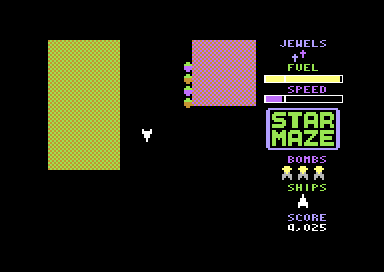
Anyway, once I start up the game, my objective is clear, find 9 power jewels in each of the 16 levels in the Star Maze. Or more precisely, take flashing crosses back to the point I spawned from. Preventing me from doing this are various enemies, and my own limited fuel supply. You'd think people in 2891 would have a better one, but then they aren't even doing this themselves. You'd also think that this fuel would lower as I thrust my ship in some direction, but it just steadily goes down. To prevent these enemies from killing me I have smart bombs and a laser gun.

The various shapes that make up the enemies are actually quite interesting. You have your asteroids that break up into smaller pieces; Two different enemies that shouldn't be attacked because they'll cause more problems after they're hurt than before; and the standard shooty enemies. If this were a well designed game this might actually be an interesting selection.
Carrying one of the cross objects
Sadly, there are many problems. Level design is randomized, so that 16 level advertisement is pointless. We've got physics! My ship and my shots bounce off walls and speed is consistent until you press another direction on the joystick. Thing is this all feels awful. The engine feels weak, which might just be my own bias towards these games, but I do notice weird things happening with my shots. But none of this compares to how the game feels.

This game is boring. Death in a game should produce frustration, or rage, or something. If I felt anything, I would say it was resignation. You start with three ships, and losing all three means starting again. It was annoying, and I wasn't about to use a save state for a game this tedious and this boring. There's just nothing interesting about it. I wonder if the man the future wimps kidnapped was as bored as I was?

Weapons:
Meh. 0/10

Enemies:
By far the only interesting aspect of the game. 3/10

Non-Enemies:
None.

Levels:
Random garbage. 0/10

Player Agency:
It works, I guess, but its not terribly exciting. 2/10

Interactivity:
None.

Atmosphere:
None.

Graphics:
More offensive than nothing. 0/10

Story:
None.

Sound/Music:
Your typical blips and bloops. Hitting the walls and getting a bouncing sound was a nice touch though. 1/10

That's 6. An embarrassment. Stay far, far away.

Tuesday, April 26, 2022

Slaygon

Name:Slaygon
Number:119
Year:1988
Publisher:MicroDeal
Developer:John Conley & James Oxley
Genre:FPS/Adventure
Difficulty:2/5
Time:1 hour 20 minutes

From the team that would bring you Day of the Viper and the publisher of Fright Night comes another weird early FPS title. This one has a very legitimate claim to the adventure label, unlike Delta Man. So much so that if this weren't connected to Day of the Viper I probably wouldn't play it. I would be willing to bet that neither TAG nor Renga in Blue will be covering this one ever.

The way outside
The player is the operator of the super robot Slaygon, an invulnerable robot. The mission? To stop the evil corporation Cybordynamics from unleashing a virus to destroy the human race. Cybordynamics is a controversial business that replaces humans with robots and other automations. To do this one has to overload their reactor in their automated lab. I wonder if this is satire, because this feels like it could be intended to be satire. It sounds like it could go either way. British games so far have a noticeable tendency to be satirical.

A door, what does it contain? Something good, hopefully
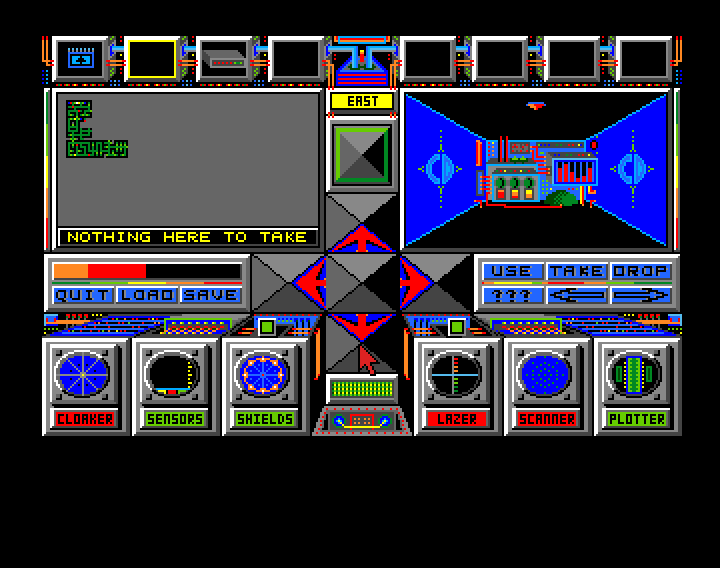
Starting it up and we're in a lobby. Not sure why since this is supposed to be automated, but I suppose this doesn't really need logic in it. The game is entirely controlled through the mouse, including movement, which is annoying and slow. We've got six functions down below, two of which are for combat; Scanner reveals a set area around you; Plotter maps as you go along, plus it shows your location; Sensors show what state the enemy is in, and I didn't really use the cloak function. Though the game tells me it makes Slaygon invisible to all enemies except the base commander, but uses a ton of energy.
Rounding out the interface, we have 8 boxes for items, the buttons above the plotter button control inventory, with the question marks telling you what an item in front of you is. Above the save/load buttons we have an energy bar, which drains on the use of all functions and acts as health. In combat, it drains considerably more if you don't have shields up. Arrows move, and basically everything else is self-explanatory. It works, I don't have any complaints about that, but its slow and feels awkward to use.
Combat, these things only show up if you open the door, you can tell if one's inside by the color of the square above the arrow button

Combat is a boring affair. There are doors in this game, and some contain these Cylon-looking fellows. As soon as you see one turn on your shield and then start firing your laser. There are seemingly no tactics, just exchange fire with the enemy until someone is dead. How much the enemy will take before it dies varies, but you can tell based on what they look like, and you can't just ignore the harder ones since they may have a valuable item behind them. Given the manual's hyping of the robot's abilities, I'm quite disappointed in how weak the player really is.

Some static object one has to use an item on to advance
The adventure aspect is very simple. Scan an item before taking it to discover what it does, and then the item will usually be used as you walk along. There are upgrades to the weapon and the shields, but you just use these, you don't need them in your inventory. Keys and various trap nullification items work automatically, while things like interfacing objects and health (energy in this game) items require use. The problem is that by the end of the game you're juggling quite a lot of items, and you can't really afford to drop most of them. The keys can be dropped after you've unlocked all the doors they correspond to though.
Only five more numbers to go!
Its not explicitly told to you (unless you look at the part of the manual they tell you contains spoilers), but the objective of the game is to find 5 numbers for a code to blow up the reactor. To figure this out you need one device that gets the numbers from one type of machine, and another device that allows you to type in the code into the reactor. The thing is, while I got 4 out of the 5 numbers needed, I was still missing one by the time I got to the reactor. I had to find two more key cards before I could get out, and I had already got around the map. So basically, in the last stages it turns into more of a maze game than anything else. And once that's done its a fairly easy trip back outside.
The end
I should note I played on the easier skill setting. The manual says that the harder one randomizes the location of some key items, but I suspect it increases the map size too. I barely had any map on my screen when I finished, seems like there was room for a lot more. Which I have to say would work quite poorly in this game's favor, because already by the time I finished it I was finding the whole experience boring.

Weapons:
I feel like just exchanging fire like a generic strategy game is one of the saddest combats I've ever seen. 0/10

Enemies:
Its kind of cool slowly figuring out the graphical differences between stronger enemies and weaker ones. 1/10

Non-Enemies:
None.

Levels:
It was shocking to discover that the game isn't randomized entirely, and that the level is pre-set to some extent. 0/10

Player Agency:
It works, but so much feels awkward and slow. 2/10

Interactivity:
I can't really think of what else to describe this game as besides an adventure game, but the amount of interaction you get here is pathetic. 1/10

Atmosphere:
None.

Graphics:
Very simple stuff. Everything looks as it should but nothing is terribly impressive. 1/10

Story:
The manual's story doesn't really have much effect on the gameplay, and doesn't entirely fit with what happens in-gameplay. 0/10

Sound/Music:
Really basic sound effects, which was quite annoying to see in an Amiga game. 1/10

That's 6.

Feels like a harsher statement against the game than it should be. Its not as horrible as that implies, it just doesn't feel like anything more than a demo. The sort of thing that shouldn't have escaped into the wild. Which is a funny thing to say about a game that was published and presumably put on store shelves, but I remain hopeful for Day of the Viper.